

Introduction
Managing social media is no longer as simple as posting a picture and writing a caption. In 2026, social media managers are expected to create engaging content, publish consistently, analyze performance, respond to audiences, manage multiple platforms, and keep up with constantly changing trends.
Artificial Intelligence (AI) is making these tasks much easier.
AI-powered social media tools can help with content ideas, captions, graphic design, video creation, scheduling, audience analysis, and even customer engagement. Instead of spending hours completing repetitive tasks, social media managers can use AI to automate parts of their workflow and focus more on strategy and creativity.
In this guide, we’ll explore some of the best AI tools for social media managers in 2026 and explain what each tool can do.
Why Social Media Managers Need AI Tools
Managing several social media accounts manually can quickly become overwhelming. A typical social media manager may need to:
- Create content calendars
- Write captions
- Design graphics
- Edit videos
- Schedule posts
- Research hashtags and trends
- Reply to comments
- Monitor brand mentions
- Analyze performance
- Prepare client reports
AI can reduce the time required for many of these tasks.
Major Benefits of AI for Social Media
- Faster content creation
- Better productivity
- Easier content planning
- Automated scheduling
- Improved audience insights
- Faster video editing
- Better consistency
- More time for creative strategy
The goal isn’t to let AI run your social media completely. Instead, use AI as a powerful assistant.
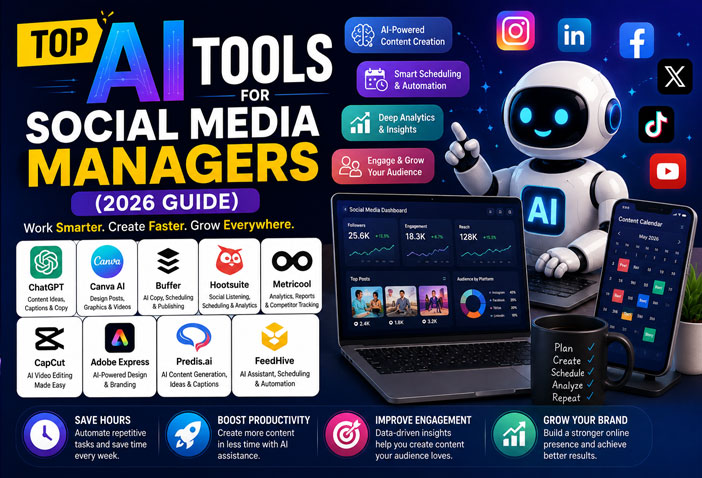
1. ChatGPT – Best for Content Ideas and Captions
ChatGPT is one of the most versatile AI assistants for social media managers.
It can help generate content ideas, captions, hooks, social media calendars, ad copy, video scripts, and campaign concepts.
For example, a social media manager handling a jewellery brand could ask AI to create a month’s worth of Instagram content ideas around weddings, festivals, new collections, and customer education.
Best Uses
- Instagram captions
- Facebook posts
- LinkedIn content
- Reel scripts
- Content calendars
- Campaign ideas
- Social media hooks
Best for: Content planning and writing.
2. Canva AI – Best for Social Media Design
Canva is one of the most useful platforms for social media managers who need attractive visuals without spending hours designing everything from scratch.
Its AI-powered features can help create designs, generate content, resize graphics, and speed up the creative process.
What You Can Create
- Instagram posts
- Instagram Stories
- Reels covers
- Facebook banners
- LinkedIn graphics
- YouTube thumbnails
- Advertisements
Canva is particularly useful when one piece of content needs to be adapted for multiple social platforms.
Best for: Graphics, branded posts, presentations, and social media creatives.
3. Buffer – AI-Powered Social Media Management
Buffer combines social media scheduling with AI-assisted content creation.
Instead of manually publishing posts on different platforms, social media managers can prepare content in advance and schedule it.
AI can also help with ideas and variations of social media copy.
Useful Features
- Social media scheduling
- Content planning
- AI writing assistance
- Performance analytics
- Multiple social accounts
Best for: Freelancers and managers handling multiple social profiles.
4. Hootsuite – Social Media Management and Analytics
Hootsuite is designed for businesses and social media teams that need centralized management.
Its AI capabilities can help with content creation, social listening, scheduling, and analytics.
Key Uses
- Schedule posts
- Monitor social conversations
- Analyze performance
- Generate content ideas
- Manage multiple accounts
- Track brand mentions
For agencies managing several clients, having everything in one dashboard can save significant time.
Best for: Businesses, agencies, and larger social media teams.
5. Metricool – Analytics and Content Planning
Creating content is only one part of social media marketing. Understanding what works is equally important.
Metricool helps social media managers schedule content and analyze performance across different platforms.
You can use analytics to understand which posts generate the most engagement and which platforms are delivering the best results.
Best Uses
- Performance tracking
- Content scheduling
- Audience analytics
- Competitor monitoring
- Social media reports
Best for: Freelancers and agencies that need client reporting.
6. CapCut – AI Video Editing
Short-form video is one of the most important formats for social media in 2026.
CapCut makes video editing easier with features such as automatic captions, templates, effects, background removal, and AI-assisted editing.
Social media managers can turn raw footage into engaging Reels and short videos much faster.
Great For
- Instagram Reels
- YouTube Shorts
- TikTok videos
- Promotional videos
- Product videos
- Talking-head content
Best for: Short-form video creation.
7. Adobe Express – AI-Powered Content Creation
Adobe Express provides an easy way to create professional social media graphics and marketing content.
Its AI-powered features can help generate and customize visual content without requiring advanced graphic design skills.
Features
- Social media templates
- AI image generation
- Background removal
- Text effects
- Quick resizing
- Brand customization
Best for: Professional-looking social media designs.
8. Predis.ai – Social Media Content Generation
Predis.ai is designed specifically for social media content creation.
It can help generate post concepts, captions, creatives, and short-form content from simple inputs.
This can be particularly useful for businesses that need to maintain a consistent posting schedule.
Best Uses
- Social media posts
- Captions
- Creative ideas
- Content calendars
- Product promotions
- Branded content
Best for: Businesses that want to speed up social content production.
9. FeedHive – AI Social Media Assistant
FeedHive combines social media scheduling, analytics, and AI-powered content assistance.
It can help users create variations of posts, improve content ideas, and manage publishing workflows.
Useful Features
- AI writing assistance
- Content scheduling
- Post recycling
- Analytics
- Social media automation
Best for: Creators, freelancers, and small businesses.
How to Choose the Right AI Social Media Tools
You don’t need ten different AI tools to manage social media effectively.
Choose tools according to your workflow.
| Task | Recommended Tool |
|---|---|
| Captions & ideas | ChatGPT |
| Graphic design | Canva AI |
| Video editing | CapCut |
| Scheduling | Buffer |
| Advanced management | Hootsuite |
| Analytics & reports | Metricool |
| Social content generation | Predis.ai |
| Design & branding | Adobe Express |
| Automation & publishing | FeedHive |
A simple combination of three or four tools can be enough for most freelancers and small businesses.
How AI Can Save Social Media Managers Time
Consider a typical workflow.
Instead of spending an entire day creating one week’s content manually, you could:
Step 1: Use ChatGPT to brainstorm content ideas.
Step 2: Create captions and Reel scripts with AI.
Step 3: Design graphics using Canva.
Step 4: Edit short videos using CapCut.
Step 5: Schedule posts using Buffer or another social media management platform.
Step 6: Analyze results using Metricool.
This workflow allows social media managers to spend more time on strategy, client communication, and creative decisions.
Don’t Let AI Replace Your Brand Voice
AI is powerful, but social media still needs a human touch.
Avoid publishing AI-generated content without reviewing it.
Before posting, check:
- Is the information accurate?
- Does it sound like the brand?
- Is the caption engaging?
- Does the visual match the brand?
- Is the call-to-action appropriate?
- Does the content provide value?
Your audience follows a brand because of its personality and connection—not simply because it posts frequently.
Future of AI in Social Media Marketing
AI will continue to influence social media management throughout 2026 and beyond.
We can expect more advanced tools for:
- Automated video creation
- Personalized content
- Predictive analytics
- AI-generated advertisements
- Automated customer responses
- Trend detection
- Audience segmentation
- Cross-platform content optimization
However, strategy, creativity, storytelling, and human judgment will remain essential.
Final Thoughts
AI tools are transforming social media management in 2026. From creating captions and graphics to editing videos, scheduling posts, and analyzing performance, AI can remove many repetitive tasks from a social media manager’s workload.
Tools such as ChatGPT, Canva AI, Buffer, Hootsuite, Metricool, CapCut, Adobe Express, Predis.ai, and FeedHive each solve different parts of the social media workflow.
The best approach is not to use every AI tool available. Start with the tools that solve your biggest problems, create a consistent workflow, and always add your own creativity and brand expertise.
When AI handles repetitive work, social media managers can spend more time doing what matters most: creating meaningful content, understanding audiences, and building strong brands.
Frequently Asked Questions
What is the best AI tool for social media managers in 2026?
There isn’t one tool that is best for every task. ChatGPT is excellent for ideas and captions, Canva for designs, CapCut for videos, and Metricool for analytics.
Can AI create social media posts?
Yes. AI can help create captions, images, content ideas, scripts, and even complete social media campaigns. Human review is still important before publishing.
Can AI manage multiple social media accounts?
Yes. Social media management platforms can help schedule and monitor multiple accounts from one dashboard.
Is AI useful for small businesses?
Absolutely. AI allows small businesses to create professional content and maintain consistent social media activity without needing a large marketing team.
Will AI replace social media managers?
AI is more likely to change the role than completely replace it. Social media managers still provide strategy, creativity, brand understanding, communication, and decision-making.