

Introduction
The way people search for information is changing rapidly in 2026.
For years, Google Search meant typing a few keywords, opening several websites, comparing information, and finding the answer yourself. Today, AI-powered search tools can understand complete questions, search the web, summarize multiple sources, and provide conversational answers.
Tools such as ChatGPT, Google AI Search, Perplexity, and Claude are now changing how people research information, compare products, learn new topics, and complete everyday tasks.
But which one should you use?
The answer depends on what you’re trying to accomplish.
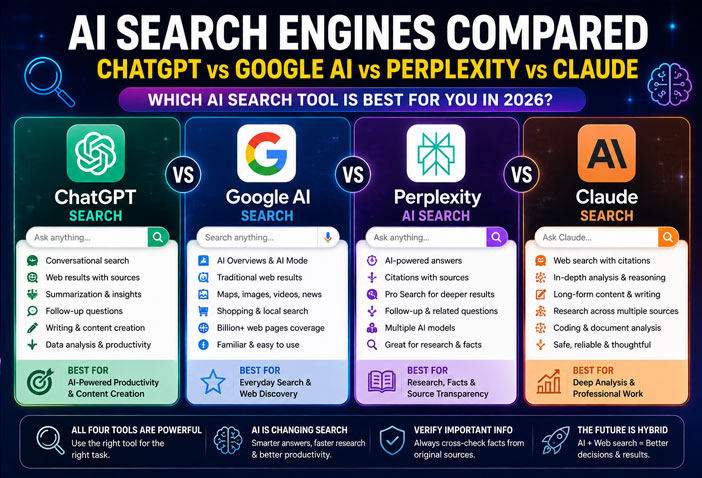
In this guide, we’ll compare ChatGPT, Google AI, Perplexity, and Claude based on search capabilities, research, citations, ease of use, writing, and everyday productivity.
What Is AI Search?
AI search combines traditional web search with artificial intelligence.
Instead of simply showing a list of links, AI-powered search can understand the context of a question and generate a summarized response using information gathered from the web.
For example, instead of searching:
“best AI tools 2026”
you can ask:
“Which AI tools are best for a small business that wants to automate marketing and customer support in 2026?”
AI search can understand the intent behind the question and provide a more conversational response.
This is one reason AI search is becoming increasingly important for both users and website owners.
1. ChatGPT Search
ChatGPT has evolved from a conversational AI assistant into a powerful web-search tool.
ChatGPT Search can access current information from the internet and provide answers with links to relevant sources. It can automatically search the web when a question would benefit from up-to-date information.
Best Features
- Web search
- Conversational follow-up questions
- Summarization
- Research assistance
- Content creation
- Brainstorming
- Data analysis
- Source links
Best For
Research + writing + productivity
ChatGPT is particularly useful when you don’t just want search results but want to understand the information and work with it.
For example, you can research a topic and then ask ChatGPT to turn the findings into a blog outline, social media post, comparison table, or business plan.
Pros
- Excellent conversational experience
- Strong writing capabilities
- Useful for follow-up questions
- Combines search with other AI capabilities
Cons
- Not designed primarily as a traditional search-results page
- Important information should still be verified against the cited sources
2. Google AI Search
Google remains the world’s most familiar search platform, but its search experience has changed significantly with AI Overviews and AI Mode.
Google’s AI Search experience can provide AI-generated answers while still connecting users to websites and traditional search results. In 2026, Google has continued expanding AI Mode and integrating it more deeply into Search.
Google announced in 2026 that AI Mode had surpassed 1 billion monthly active users globally, with AI Mode queries more than doubling every quarter since launch.
Best Features
- AI Overviews
- AI Mode
- Traditional search results
- Website links
- Multimodal search
- Follow-up questions
- Product and local search
Best For
Everyday web search and discovering websites
Google has a major advantage because it combines AI answers with the enormous ecosystem of websites, images, maps, videos, shopping results, and other search features.
Pros
- Excellent web coverage
- Familiar interface
- Strong local and shopping search
- Combines AI answers with traditional results
- Excellent for finding original websites
Cons
- AI answers aren’t always the final word
- Search experience can vary depending on query and location
- Users may still need to open multiple sources for deeper research
3. Perplexity
Perplexity is specifically designed around AI-powered search and answer generation.
Instead of simply giving you a list of websites, Perplexity searches the web and produces a conversational answer with citations and links to the original sources.
Its Pro Search feature can conduct deeper searches across multiple sources and synthesize the findings into a more detailed response.
Best Features
- AI-powered search
- Source citations
- Pro Search
- Deep Research
- Follow-up questions
- Multiple AI models
- Academic and professional research
Best For
Research and fact-finding
If you’re researching a topic for a blog, business project, academic assignment, or market analysis, Perplexity is particularly useful because sources are prominently presented alongside the answer.
Perplexity’s current platform also supports multiple AI models, including models from OpenAI and Anthropic, depending on the plan and mode.
Pros
- Excellent source transparency
- Strong research workflow
- Fast answers
- Great for comparing information
- Useful citation system
Cons
- Some advanced research features require paid access
- AI summaries still need verification
4. Claude
Claude is primarily known as an AI assistant, but it also supports web search and research capabilities.
Claude’s web search allows it to retrieve current information from the internet and provide citations. Its Research feature can conduct multiple searches and investigate different aspects of a question before producing a detailed answer.
Best Features
- Web search
- Research
- Long-form analysis
- Writing assistance
- Document analysis
- Coding
- Follow-up conversations
Best For
Deep analysis and professional work
Claude can be especially useful when you want to combine current web information with detailed reasoning, writing, document analysis, or other work.
Anthropic’s current Claude models also focus heavily on coding, agents, research, and professional tasks.
Pros
- Strong long-form writing
- Excellent analysis
- Useful research capabilities
- Good for professional workflows
Cons
- Search is not the primary identity of the product
- Some advanced Research functionality depends on paid plans
ChatGPT vs Google AI vs Perplexity vs Claude
| Feature | ChatGPT | Google AI | Perplexity | Claude |
|---|---|---|---|---|
| Web Search | ✅ | ✅ | ✅ | ✅ |
| Conversational Search | ✅ | ✅ | ✅ | ✅ |
| Source Citations | ✅ | ✅ | ✅ | ✅ |
| Deep Research | ✅ | ✅ | ✅ | ✅ |
| Traditional Search Results | Limited | ✅ | Limited | ❌ |
| Writing | ⭐⭐⭐⭐⭐ | ⭐⭐⭐ | ⭐⭐⭐⭐ | ⭐⭐⭐⭐⭐ |
| Research | ⭐⭐⭐⭐⭐ | ⭐⭐⭐⭐ | ⭐⭐⭐⭐⭐ | ⭐⭐⭐⭐⭐ |
| Website Discovery | ⭐⭐⭐⭐ | ⭐⭐⭐⭐⭐ | ⭐⭐⭐⭐ | ⭐⭐⭐ |
| Best for Everyday Search | ⭐⭐⭐⭐ | ⭐⭐⭐⭐⭐ | ⭐⭐⭐⭐ | ⭐⭐⭐ |
| Best for Long-form Work | ⭐⭐⭐⭐⭐ | ⭐⭐⭐ | ⭐⭐⭐⭐ | ⭐⭐⭐⭐⭐ |
Capabilities and availability can vary by plan, region, and product mode.
Which AI Search Tool Is Best for You?
There’s no single winner for every type of search.
Choose ChatGPT If:
You want an AI assistant that can search the web and then help you write, brainstorm, analyze, or transform the information into something useful.
Best overall for: AI-assisted productivity.
Choose Google AI If:
You want a combination of AI answers, traditional search results, websites, images, maps, shopping, videos, and other Google services.
Best overall for: Everyday web search.
Choose Perplexity If:
Your priority is research and finding answers with clearly presented sources.
Best overall for: Research and fact-checking.
Choose Claude If:
You want detailed analysis, long-form writing, coding, and research in the same workflow.
Best overall for: Professional knowledge work.
AI Search vs Traditional Google Search
Traditional search and AI search aren’t necessarily competitors.
They can work together.
Traditional search is excellent when you want:
- A specific website
- A particular product
- Maps and local businesses
- Official documentation
- News sources
- Multiple search results
AI search is particularly useful when you want:
- A summarized explanation
- Comparisons
- Complex research
- Follow-up questions
- Multiple sources synthesized together
The best approach is often to use AI for understanding a topic and then open the original sources for verification.
Why AI Search Matters for Bloggers and Website Owners
AI search is also changing SEO.
Users may discover information through AI-generated answers instead of clicking through traditional search results.
This means websites increasingly need to focus on:
- High-quality original content
- Accurate information
- Strong topical coverage
- Clear website structure
- Authoritative sources
- Helpful answers
- Original research and examples
Simply stuffing keywords into an article is not enough.
The goal should be to create content that is genuinely useful and trustworthy.
The Future of AI Search
AI search is likely to become more conversational, personalized, and multimodal.
Users will increasingly search using:
- Text
- Images
- Voice
- Videos
- Files
- Longer conversational questions
Google is already expanding AI Mode beyond traditional keyword search, while Perplexity and other AI platforms are investing heavily in deeper research workflows.
The future of search isn’t necessarily about choosing between AI and traditional search.
Instead, search is evolving into a combination of web discovery + AI reasoning + personalized answers.
Final Verdict
So, which AI search engine should you choose in 2026?
For everyday searching: Google AI
For AI-powered productivity: ChatGPT
For research and citations: Perplexity
For deep analysis and professional work: Claude
Rather than choosing only one, many users can benefit from using different tools for different tasks.
AI search has fundamentally changed the way we find and understand information. The biggest advantage isn’t simply getting an answer faster—it’s being able to ask better questions, explore information conversationally, compare multiple sources, and turn research into useful work.
As these platforms continue to evolve, knowing how to use AI search effectively will become an increasingly valuable digital skill.
Frequently Asked Questions
Which is better, ChatGPT or Perplexity for research?
Both are capable research tools. Perplexity is particularly strong when source visibility and web research are the priority, while ChatGPT is useful when you want to combine web research with writing, analysis, and other AI-assisted tasks.
Is Google AI better than ChatGPT?
It depends on the task. Google AI is excellent for broad web discovery and traditional search features, while ChatGPT is particularly useful for conversational research and turning information into useful outputs.
Is Perplexity better than Google Search?
For research-style questions, Perplexity can be more convenient because it synthesizes sources into an answer. Google remains extremely useful for discovering websites, local information, products, videos, and a broad range of search results.
Can Claude search the internet?
Yes. Claude supports web search and can provide citations from information it retrieves from the web.
Which AI search tool is best for bloggers?
Perplexity and ChatGPT are particularly useful for topic research and content planning, while Google remains important for understanding search behavior, discovering competing pages, and finding original sources.