

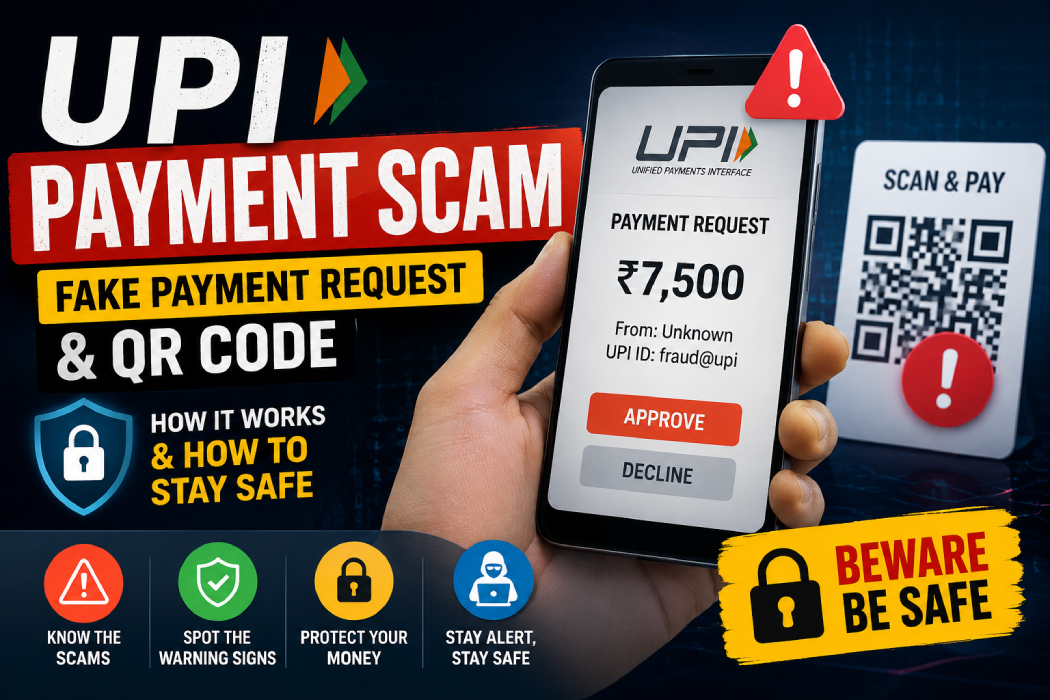
UPI has made digital payments in India fast, convenient, and accessible. From paying at local shops to sending money to friends, millions of people use UPI every day. However, the growing popularity of digital payments has also attracted scammers who use fake payment requests, QR codes, calls, messages, and social engineering tricks to steal money.
One of the most common fraud methods involves convincing a person to scan a QR code or approve a UPI payment request under the impression that they are receiving money.
Understanding how these scams work can help you protect your bank account and avoid unnecessary financial losses.
What Is a UPI Payment Scam?
A UPI payment scam occurs when a fraudster tricks someone into authorizing a transaction or revealing sensitive banking information.
The scammer may pretend to be:
- A buyer or seller
- A bank representative
- A delivery executive
- A customer-care agent
- A government official
- A friend or relative
- A company representative
The victim is then manipulated into making a payment, approving a collect request, scanning a malicious or misleading QR code, or sharing sensitive information.
The important thing to remember is that receiving money does not normally require you to enter your UPI PIN. Your UPI PIN is generally used to authorize payments from your account.
How Fake QR Code Scams Work
QR-code scams are particularly dangerous because scammers often create a sense of urgency.
For example, imagine that you are selling a product online. A person contacts you and says they want to purchase it. Instead of sending money, they send you a QR code and claim:
“Scan this code to receive your payment.”
You scan it and follow the instructions. Your payment app then asks you to enter your UPI PIN.
If you approve the transaction, you may actually be sending money to the scammer instead of receiving it.
Remember This Simple Rule
Scanning a QR code does not automatically mean you are receiving money.
Always check the transaction details shown by your UPI app before approving anything.
Common UPI Payment Scam Methods
1. Fake Payment Request
A scammer may send a UPI collect request and tell you that it is required to receive a payment.
They might say:
- “Please approve the request.”
- “Accept this request to receive your refund.”
- “Click approve and the money will be credited.”
- “This is a verification transaction.”
If you approve a request without checking it, you could authorize a payment from your own account.
2. Fake Buyer Scam
This scam commonly targets people selling products through online marketplaces.
A fake buyer contacts the seller and claims they want to purchase an item. The scammer may send a QR code or payment request and say it is necessary to receive the money.
Instead of receiving money, the seller may unknowingly authorize a payment.
3. Fake Customer-Care Scam
Scammers sometimes create fake customer-support numbers or profiles.
A person searching online for support may contact a fake representative. The scammer then asks for:
- UPI PIN
- OTP
- Card information
- Screen-sharing access
- Banking credentials
Never share your UPI PIN or OTP with anyone claiming to be customer support.
4. Refund Scam
Another common trick involves fake refunds.
A scammer may claim:
“Your refund is ready. Please scan this QR code to receive it.”
They may also send a payment request.
Before approving anything, verify the refund through the company’s official app or website.
5. Fake Delivery or Courier Scam
A fraudster may contact you pretending to be a courier or delivery representative.
They may claim that a small payment is required for:
- Delivery
- Customs
- Address verification
- Rescheduling
- Cancellation
The payment request may actually be fraudulent.
6. Friend or Relative Impersonation
Scammers can also pretend to be someone you know.
They may message you from an unfamiliar number and say they urgently need money.
Before sending money, call the person directly using their known phone number and verify the request.
Warning Signs of a UPI Scam
Be particularly careful when someone:
- Creates unnecessary urgency
- Asks you to scan an unexpected QR code
- Sends an unexpected collect request
- Asks for your UPI PIN
- Requests an OTP
- Asks you to install an unknown app
- Requests screen-sharing access
- Claims you must pay money to receive money
- Offers an unusually attractive deal
- Threatens account suspension unless you act immediately
Scammers often rely on fear, urgency, excitement, or confusion to make victims act without thinking.
How to Avoid UPI Payment Scams
1. Never Share Your UPI PIN
Your UPI PIN is confidential.
No genuine bank representative, payment-service employee, or customer-care agent should ask you to disclose it.
If someone asks for your UPI PIN, treat it as a major warning sign.
2. Check Before Approving a Payment
Before entering your UPI PIN, carefully check:
- Recipient name
- Amount
- Transaction details
- Payment purpose
If anything looks unfamiliar, cancel the transaction.
3. Don’t Scan QR Codes to Receive Money
A QR code can be used to initiate a payment.
If someone says:
“Scan this QR code and enter your UPI PIN to receive money,”
stop and verify the transaction.
4. Don’t Trust Screenshots as Proof of Payment
A scammer may send a fake payment screenshot and claim that they have transferred money.
Instead of relying on screenshots, check your actual bank account or transaction history.
5. Avoid Unknown Links
Do not click suspicious links received through SMS, WhatsApp, email, or social media.
Scammers may use fake links to redirect you to fraudulent websites or pages designed to steal information.
6. Never Give Remote Access
Be careful if someone asks you to install a screen-sharing or remote-access application to “help” with a payment problem.
Remote access can potentially allow another person to see or control activity on your device.
7. Verify Unexpected Requests
If someone claims to be your friend, family member, company, bank, or delivery service, verify the request through an official channel.
Do not rely solely on the number or profile that contacted you.
What to Do If You Accidentally Sent Money to a Scammer
If you realize that you have been scammed, act quickly.
Step 1: Contact Your Bank
Immediately inform your bank or the relevant payment service about the fraudulent transaction.
Ask them what emergency measures are available for your account and transaction.
Step 2: Report the Cyber Fraud
In India, financial cyber fraud can be reported through the government’s National Cyber Crime Reporting Portal and the cybercrime helpline 1930.
When reporting, keep important information ready, such as:
- Transaction ID
- Date and time
- Amount
- UPI ID
- Bank details
- Screenshots
- Phone numbers
- Messages or emails connected with the scam
The faster a fraudulent transaction is reported, the better the chance of initiating appropriate recovery or blocking measures.
Step 3: Secure Your Accounts
If you shared sensitive information, take steps to secure your accounts.
Consider:
- Changing compromised passwords
- Contacting your bank
- Blocking compromised cards if necessary
- Reviewing recent transactions
- Removing suspicious applications
- Checking account-security settings
UPI Safety Rules Everyone Should Remember
Here are some simple rules that can prevent many UPI scams:
Rule 1: UPI PIN is for authorizing payments, not receiving money.
Rule 2: Never share your UPI PIN or OTP.
Rule 3: Always verify the recipient before paying.
Rule 4: Don’t approve unexpected collect requests.
Rule 5: Don’t scan unknown QR codes.
Rule 6: Never trust payment screenshots alone.
Rule 7: Don’t install unknown apps at someone’s request.
Rule 8: Don’t give strangers remote access to your phone.
Rule 9: Verify urgent money requests independently.
Rule 10: Report suspected fraud immediately.
Final Thoughts
UPI is one of the most convenient ways to make digital payments, but convenience also means users need to stay alert.
Most UPI scams don’t require sophisticated hacking. Instead, scammers often rely on social engineering—convincing people to approve transactions or reveal sensitive information themselves.
The safest approach is simple: slow down, verify every unexpected payment request, and never share your UPI PIN or OTP with anyone.
Remember: You do not need to enter your UPI PIN simply to receive money. If someone tells you otherwise, stop the transaction and verify the request through an official channel.
A few seconds of caution can protect your hard-earned money from a potentially costly scam.
Frequently Asked Questions (FAQs)
Can someone take money by sending a QR code?
A QR code itself does not automatically take money from your account. However, scammers may use QR codes to trick you into initiating a payment. Always check the payment details before entering your UPI PIN.
Do I need a UPI PIN to receive money?
Generally, no. Your UPI PIN is used to authorize payments from your account. Be suspicious if someone tells you that you must enter your UPI PIN to receive money.
What should I do if I accidentally approved a fraudulent UPI transaction?
Contact your bank or payment service immediately and report the transaction. You should also report financial cyber fraud through India’s official cybercrime reporting channels, including 1930.
Is it safe to accept a UPI collect request?
Only approve a collect request when you recognize and expect it. Review the recipient and amount carefully before authorizing the transaction.
Can a scammer steal money if I only share my UPI ID?
A UPI ID alone generally isn’t enough to authorize a payment from your account. However, scammers can use it as part of broader fraud attempts, so never share your UPI PIN, OTP, card details, or other confidential information.