

Website vs Instagram: What Does a Small Business Need First?
If you are starting a small business, one question often comes up:
Should I create a website first, or should I start promoting my business on Instagram?
Both can help a business build an online presence, but they serve different purposes.
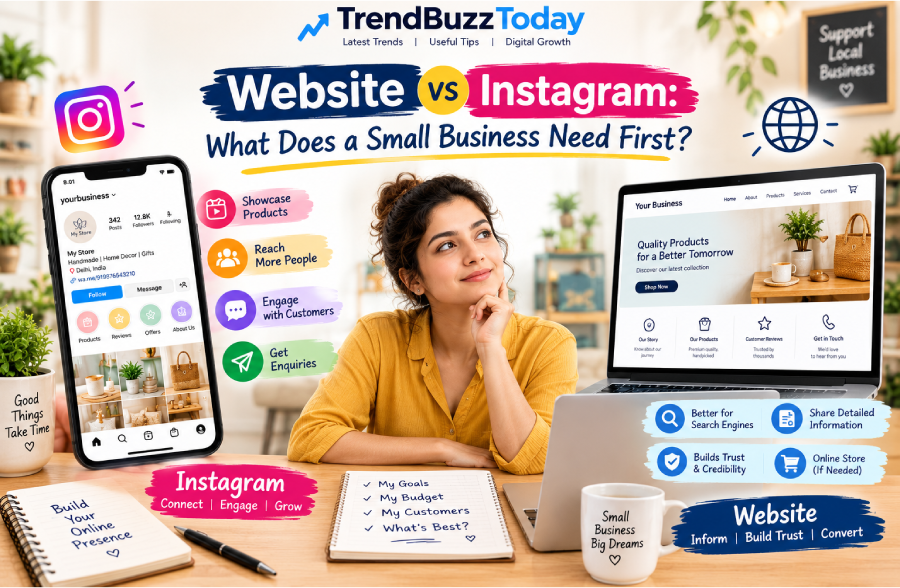
Instagram can help you reach people, showcase your products and interact with potential customers, while a website can give your business a dedicated online home where customers can learn about your business, products and services.
So, which one should a small business start with?
The answer depends on your business, customers, budget and goals.
Let’s compare both options.
Website vs Instagram: What’s the Difference?
Before deciding, it is important to understand what each platform does.
Instagram is primarily a social media and content platform.
Businesses can use it to:
- Showcase products and services
- Share photos and videos
- Publish Reels and Stories
- Interact with customers
- Build an audience
- Receive enquiries
- Promote offers and new products
Instagram is particularly useful for businesses that have visually appealing products or services.
Website
A website is your own dedicated online presence.
A business website can include:
- About your business
- Products and services
- Pricing or product information
- Contact details
- Business location
- Customer testimonials
- Portfolio
- Blog
- Online enquiry forms
- Online store
Unlike a social media profile, a website gives you much more control over how your business information is presented.
Website vs Instagram: Quick Comparison
| Feature | Website | |
|---|---|---|
| Online presence | Dedicated business platform | Social media profile |
| Product showcase | Yes | Yes |
| Customer engagement | Forms, chat and other tools | Comments, DMs and Stories |
| Content discovery | Search engines and direct visits | Instagram discovery and recommendations |
| Design control | High | Limited to platform features |
| Long-form information | Excellent | Limited |
| Reels/Stories | No | Yes |
| Direct audience building | Through traffic, SEO, email, etc. | Strong social audience-building features |
| Online store | Can be built into website | Shopping features may be available depending on eligibility/region |
| Brand ownership | More control | Dependent on platform |
Why Small Businesses Should Consider Instagram
For many new businesses, Instagram can be a relatively simple way to start showing what they offer.
You can create a profile, add your business information and start publishing content.
1. Easy Product Showcase
A jewellery store can post jewellery designs.
A clothing business can showcase new collections.
A salon can share hairstyles and beauty work.
A bakery can post cakes and customer orders.
Visual content can help potential customers understand what your business offers.
2. Direct Customer Interaction
Instagram allows businesses to interact with potential customers through comments and messages.
Someone may see a product and ask:
“What’s the price?”
or
“Do you deliver in my area?”
That conversation can become a business enquiry.
3. Reels and Stories
Reels and Stories provide additional ways to keep customers updated.
Businesses can use them for:
- New products
- Behind-the-scenes content
- Offers
- FAQs
- Customer reviews
- Product demonstrations
4. Useful for Building Awareness
Instagram can help businesses introduce their brand to people who may not already know about them.
However, building an audience takes consistency. Having an Instagram account does not automatically mean that customers will find or buy from the business.
Why a Small Business Should Consider a Website
A website serves a different purpose.
Instead of relying entirely on a social media profile, your business gets a dedicated online destination.
1. Your Business Gets Its Own Online Home
Your website can become the central place where customers find information about your business.
For example:
Your Instagram → Website → Product/Service → Enquiry
This creates a clear customer journey.
2. More Space for Information
Instagram is excellent for short-form visual content, but a website can provide detailed information.
You can create separate pages for:
- Products
- Services
- About Us
- Contact
- FAQs
- Portfolio
- Blog
3. Helps With Search Engine Visibility
A website can be optimized for search engines so that people can potentially discover your business through relevant Google searches.
For example, a local business could create useful pages around its products, services and location.
SEO takes time and does not guarantee a particular search ranking, but a website provides a foundation for a broader search strategy.
4. Builds a More Complete Brand Presence
A professionally designed website can provide customers with detailed information about your business, services, products, policies and contact options.
This can be especially useful when customers want to research a business before making a purchase.
Should a New Business Start With Instagram or a Website?
There is no single answer for every business.
Consider these situations.
If Your Budget Is Very Limited
Instagram can be a practical starting point because you can begin building a social presence without first investing in a full website.
However, you should still secure your business name/domain if possible so you have the option of building a website later.
If You Sell Highly Visual Products
Businesses such as:
- Jewellery
- Fashion
- Beauty
- Food
- Home decor
- Handmade products
may find Instagram useful for showcasing products visually.
If You Offer Professional Services
Businesses such as:
- Consultants
- Digital marketing agencies
- Designers
- Developers
- Accountants
- Coaches
can benefit from a website because it gives them space to explain their services, experience, portfolio and contact process.
If Customers Search for Your Business on Google
A website can be particularly useful when potential customers actively search for your products or services online.
For local businesses, a Google Business Profile + website + social media presence can work together as part of a broader digital strategy.
What If You Can Afford Both?
If your budget and time allow, you don’t necessarily have to choose one.
A website and Instagram can support each other.
For example:
Instagram → Attract attention
Website → Provide detailed information
Google → Help people discover your business
WhatsApp/Phone → Handle enquiries
This creates a more complete digital presence.
How Instagram and a Website Can Work Together
Imagine you own a jewellery business.
You publish a Reel showing a new necklace collection.
A potential customer sees the Reel and becomes interested.
You can direct them to your website where they can:
- See more products
- Learn about your business
- Check available information
- View contact details
- Submit an enquiry
The website doesn’t replace Instagram, and Instagram doesn’t replace the website. They can perform different jobs in the customer journey.
What About a Small Home-Based Business?
A home-based business does not necessarily need an expensive website on day one.
You can start with:
- Instagram business profile
- Google Business Profile, where eligible
- WhatsApp Business
- A simple website or landing page when needed
As your business grows, you can add more website features.
What Should a Small Business Website Include?
You don’t need dozens of pages when you’re starting.
A simple business website can include:
Home Page
Explain what your business does and what you offer.
About Page
Tell customers about your business.
Products or Services
Show what customers can buy or enquire about.
Contact Page
Add your phone number, email, location and enquiry options.
Testimonials
Where appropriate, display genuine customer feedback.
FAQ
Answer common customer questions.
A small, well-organized website can be more useful than a large website filled with unnecessary information.
Common Mistakes to Avoid
Depending Only on Instagram
Social media platforms can change their features, algorithms and policies. Building your entire online presence around one platform can limit your options.
Creating a Website and Never Updating It
An outdated website can provide incorrect information to customers.
Keep important information such as phone numbers, services, products and business hours updated.
Focusing Only on Followers
Followers are not the only measure of business success.
Look at meaningful actions such as:
- Enquiries
- Calls
- Website visits
- Product interest
- Leads
- Orders
Building a Website Without a Clear Goal
Before creating a website, decide what you want visitors to do.
Do you want them to:
- Call you?
- Send an enquiry?
- Buy a product?
- Book an appointment?
- Visit your store?
A clear goal makes website planning easier.
A Simple Digital Strategy for Small Businesses
If you’re starting with a limited budget, you can build your online presence step by step.
Stage 1: Get Started
Create:
- Instagram Business Account
- WhatsApp Business
- Google Business Profile, if eligible
Stage 2: Build Your Website
Create a simple website with:
- Home
- About
- Products/Services
- Contact
Stage 3: Grow Your Content
Regularly publish:
- Instagram posts
- Reels
- Stories
- Blog articles
- Customer experiences
Stage 4: Improve Your Online Presence
As your business grows, consider:
- Local SEO
- Website SEO
- Online advertising
- Email marketing
- Online booking
- E-commerce
- Analytics
This approach allows you to build your digital presence gradually instead of spending heavily at the beginning.
Final Thoughts
So, website or Instagram—which should a small business choose first?
There is no universal answer.
Instagram can be useful for building awareness, showcasing products and interacting with customers, while a website can provide a dedicated and more controlled online destination for your business.
For many businesses, the most useful long-term approach may be to use both: let social media help people discover and engage with your brand, while your website provides detailed information and a central place for customers to take action.
Start with what matches your current budget and business goals, then build your digital presence as your business grows.