

Introduction
Starting a blog is easy. Growing it from zero visitors to thousands—or even 100,000 monthly visitors—is the difficult part.
Bloggers have to research topics, create useful content, optimize articles for search engines, promote posts, analyze traffic, and publish consistently. Doing everything manually can take a huge amount of time.
In 2026, Artificial Intelligence (AI) is changing the way bloggers approach these tasks. AI can help with keyword research, content planning, outlines, optimization, social media promotion, analytics, and many other parts of blogging.
However, AI alone will not magically bring 100K visitors. The real advantage comes from using AI as a productivity and research assistant while keeping human expertise, originality, and quality at the center of your blog strategy.
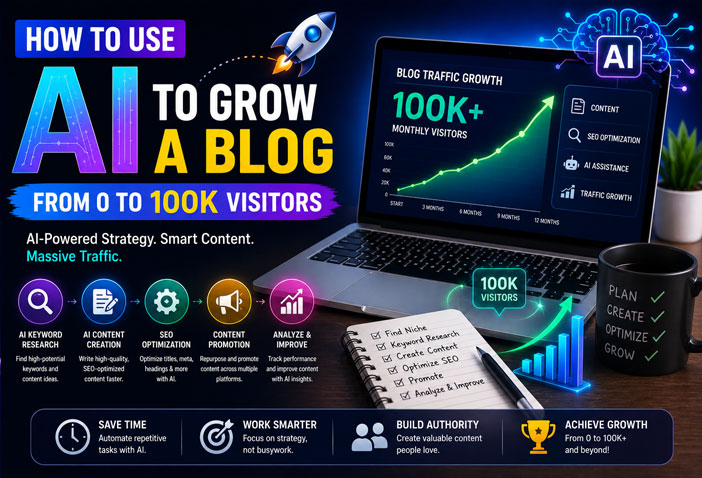
Here’s a practical roadmap for using AI to grow a blog from 0 to 100K visitors.
1. Choose a Clear Blog Niche
Before publishing hundreds of articles, choose a specific niche.
A focused blog makes it easier to build authority and attract the right audience.
For example, instead of creating a website about “everything related to technology,” you could focus on:
- AI tools and software
- AI for small businesses
- Blogging and SEO
- Productivity tools
- Digital marketing
- WordPress and website development
AI can help you analyze potential niches by identifying common questions, content gaps, competitors, and topics people are searching for.
Tip
Choose a niche where you can consistently create useful content for at least several months.
2. Use AI for Keyword and Topic Research
One of the biggest advantages of AI is its ability to help generate content ideas quickly.
Instead of randomly choosing topics, use AI to build topic clusters around your main niche.
For example, if your blog focuses on AI tools, you could create clusters such as:
AI Productivity
- Best AI productivity tools
- AI tools for freelancers
- AI Chrome extensions
- AI scheduling apps
AI Content Creation
- AI writing tools
- AI video generators
- AI image generators
- AI voice generators
AI for Business
- AI tools for small businesses
- AI customer service tools
- AI marketing automation
- AI tools for sales
This approach gives your website a logical content structure and helps you cover a subject comprehensively.
3. Create an AI-Powered Content Calendar
Consistency is one of the biggest challenges for bloggers.
AI can help create a realistic content calendar based on your niche, audience, and publishing schedule.
For example, you could plan:
- Monday: AI tools article
- Wednesday: How-to guide
- Friday: Comparison article
- Sunday: Industry trend article
You can also use AI to turn one broad topic into multiple related articles.
Instead of writing one article about “AI productivity,” you could create separate posts about AI productivity apps, Chrome extensions, AI note-taking tools, AI meeting assistants, and AI automation.
This gives your blog more opportunities to attract search traffic.
4. Use AI to Build Better Article Outlines
Before writing an article, create a detailed outline.
AI can help identify:
- Important subtopics
- Frequently asked questions
- Related concepts
- Potential H2 and H3 headings
- Missing information competitors may have overlooked
But don’t simply copy an AI-generated outline.
Add your own experience, examples, opinions, screenshots, comparisons, and practical advice.
The goal is to make your article more useful than existing results, not simply longer.
5. Create Helpful Content with AI Assistance
AI can dramatically speed up the writing process.
You can use it to:
- Create first drafts
- Rewrite complicated explanations
- Generate examples
- Improve readability
- Create FAQs
- Suggest headlines
- Write meta descriptions
However, publishing hundreds of generic AI-generated articles isn’t a reliable growth strategy.
Your content should provide something valuable that readers cannot get from a basic AI-generated answer.
Add:
- Original examples
- Personal experience
- Expert opinions
- Screenshots
- Product comparisons
- Case studies
- Data and research
- Practical step-by-step instructions
AI should help you create better content faster, not simply create more content.
6. Optimize Articles for SEO
After writing an article, AI can help identify potential SEO improvements.
You can ask AI to review:
- Title
- Meta description
- Heading structure
- Keyword usage
- Internal linking opportunities
- Search intent
- FAQ ideas
- Content gaps
Don’t focus on repeating a keyword unnaturally.
Instead, make sure the article clearly answers the searcher’s question and covers the topic comprehensively.
A strong SEO article should be useful to humans first.
7. Build a Strong Internal Linking System
Internal links are often overlooked by new bloggers.
When you publish a new article, look for older related posts that can link to it.
For example:
AI Productivity Tools → AI Chrome Extensions → AI Tools for Freelancers → AI Automation Tools
This creates a connected content network.
AI can help identify relevant articles and suggest anchor text, making internal-link management much easier as your website grows.
8. Repurpose Every Blog Post
One article can become many pieces of content.
For example, a single blog post can be converted into:
- LinkedIn posts
- Instagram carousel ideas
- X posts
- Short video scripts
- YouTube Shorts ideas
- Pinterest content
- Email newsletter content
AI can help transform your long-form article into these different formats.
This allows you to promote one piece of content across multiple platforms without starting from scratch every time.
9. Use AI to Analyze Your Traffic
Once your blog starts receiving visitors, data becomes extremely important.
Use analytics and search-performance data to identify:
- Which articles receive the most traffic
- Which keywords generate impressions
- Which pages have low click-through rates
- Which articles are losing traffic
- Which topics deserve more content
AI can help interpret these patterns and suggest opportunities.
For example, if an article receives many search impressions but few clicks, improving the title and meta description could potentially increase its CTR.
10. Update Old Content Regularly
Growing a blog isn’t only about publishing new articles.
Older posts can become valuable traffic sources if you keep them updated.
Review important articles periodically and update:
- Statistics
- Product information
- Screenshots
- Broken links
- Outdated recommendations
- Titles and descriptions
- Internal links
AI can help identify outdated sections and suggest areas that need improvement.
11. Focus on Quality Before Quantity
Publishing 500 weak articles won’t necessarily produce 100K visitors.
A better strategy is to build a library of genuinely useful content.
Focus on:
Search Intent + Quality + Originality + Internal Linking + Promotion + Consistency
AI can make each stage faster, but the strategy still needs human direction.
A Simple AI Blogging Workflow
Here’s a practical workflow you can follow:
Step 1: Find a topic opportunity
↓
Step 2: Research keywords and search intent
↓
Step 3: Create an article outline with AI
↓
Step 4: Write and edit the article
↓
Step 5: Add original insights and examples
↓
Step 6: Optimize title, headings, links, and metadata
↓
Step 7: Publish and submit for indexing
↓
Step 8: Promote on social media
↓
Step 9: Monitor search performance
↓
Step 10: Update and improve the article
Repeat this process consistently.
How Long Does It Take to Reach 100K Visitors?
There is no guaranteed timeline.
Some websites grow quickly because they target the right audience, publish excellent content, earn strong backlinks, and benefit from trending topics. Others take years to reach significant traffic.
Instead of obsessing over the 100K number, focus on smaller milestones:
0 → 100 visitors/month
100 → 1,000
1,000 → 10,000
10,000 → 50,000
50,000 → 100,000+
Each stage requires better content, stronger SEO, more authority, and deeper understanding of your audience.
Common Mistakes to Avoid
Publishing AI Content Without Editing
AI-generated content can contain errors, outdated information, or generic explanations. Always review and improve it.
Targeting Only High-Competition Keywords
New websites often have better opportunities with specific, long-tail topics.
Ignoring Search Intent
An article can rank poorly if it doesn’t satisfy what users actually want from the search.
Never Updating Old Articles
Content can lose relevance over time. Regular updates can keep important pages useful.
Focusing Only on Google
Social media, newsletters, communities, referrals, and other channels can also bring valuable visitors.
Final Thoughts
Growing a blog from 0 to 100K visitors is a long-term process, but AI can make the journey much more efficient.
From topic research and content planning to SEO optimization, internal linking, promotion, and analytics, AI can reduce the amount of repetitive work involved in running a successful blog.
But remember: AI is the assistant, not the strategy.
The blogs that stand out in 2026 will be those that combine AI’s speed with human expertise, original ideas, useful information, and a genuine understanding of readers.
Start with a focused niche, create valuable content consistently, build topic clusters, optimize your existing articles, and use data to improve your strategy.
You don’t need 100K visitors on day one.
You need to build the right system—and keep improving it.
Frequently Asked Questions
Can AI really help grow a blog?
Yes. AI can assist with research, planning, writing, SEO, content repurposing, and analytics. However, successful growth still depends on content quality, strategy, consistency, and audience demand.
Can I create an entire blog using AI?
AI can help with many parts of building a blog, but human review and original contributions are important. Readers need useful, accurate, and trustworthy content rather than generic automated articles.
How many articles do I need to reach 100K visitors?
There is no fixed number. A smaller website with highly valuable content can outperform a larger website with hundreds of weak articles.
Is SEO still important for blogs in 2026?
Yes. Search visibility remains an important traffic source, although bloggers should also diversify through social media, email, communities, and other channels.
What is the best way to use AI for blogging?
Use AI for research, brainstorming, outlines, editing, optimization, and repetitive tasks while keeping human expertise, originality, fact-checking, and final editorial decisions at the center.