


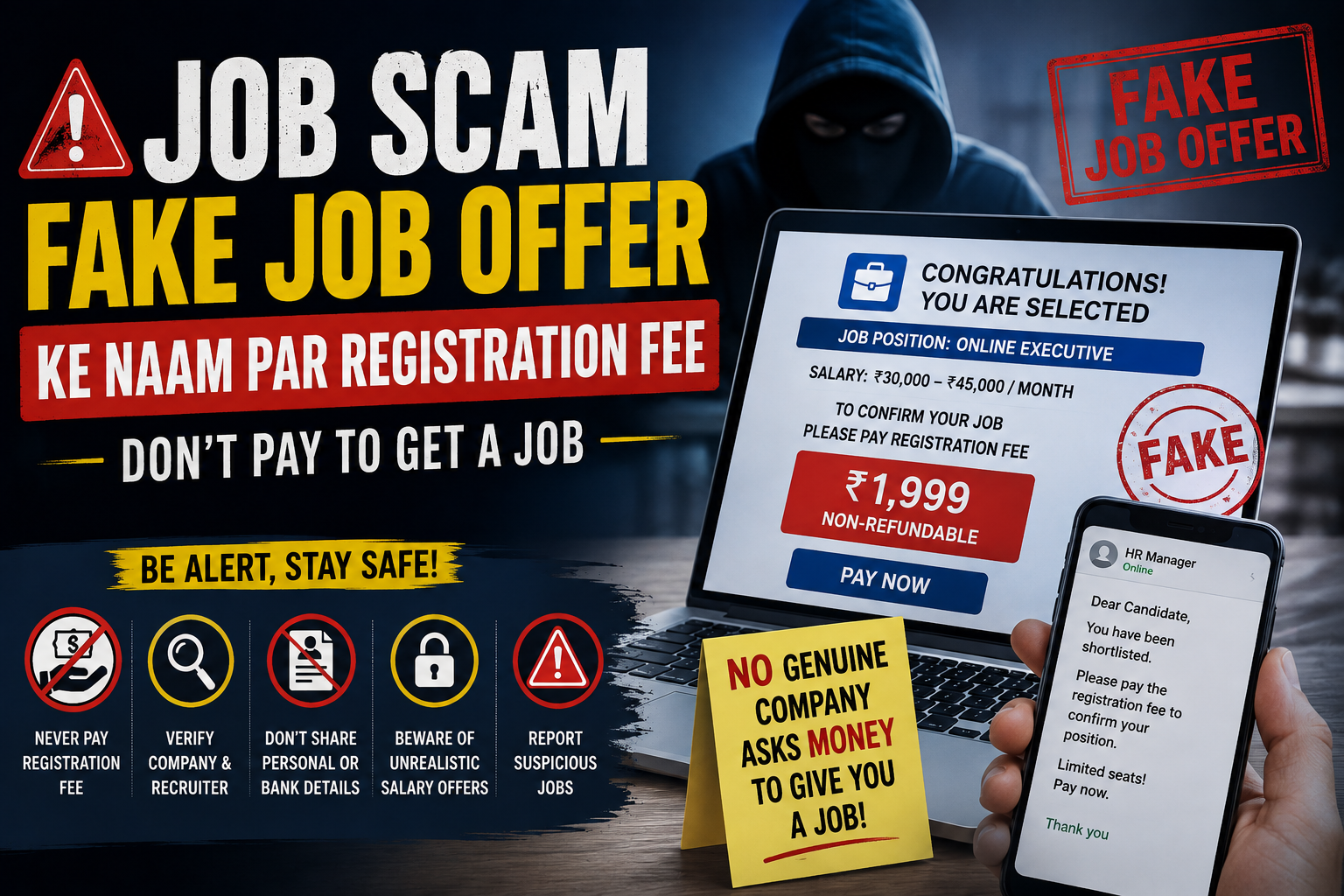
Finding a job online has become easier than ever. Job portals, social media, messaging apps, and recruitment websites allow candidates to discover new opportunities within minutes. However, this convenience has also created opportunities for scammers.
Job scams are one of the common forms of online fraud, where criminals create fake job advertisements, impersonate recruiters, or contact job seekers with attractive employment offers. The scammer may then ask for a registration fee, interview fee, security deposit, document-verification charge, training fee, or other payment.
The biggest warning sign is simple:
A genuine job opportunity should not require you to pay money simply to get selected.
In this guide, we explain how job scams work, how to identify fake job offers, and what you should do if you think you have been targeted.
What Is a Job Scam?
A job scam is a fraudulent employment opportunity designed to steal money, personal information, or both from job seekers.
Scammers may advertise fake positions such as:
- Work-from-home jobs
- Data-entry jobs
- Customer-support jobs
- Back-office jobs
- Government jobs
- Banking jobs
- Receptionist jobs
- Delivery jobs
- Sales jobs
- International jobs
- Part-time jobs
The offer may look genuine at first. The scammer might even create a fake company website, recruitment letter, interview process, or employee ID to make the opportunity appear legitimate.
After gaining the candidate’s trust, the scammer asks for money or sensitive information.
How Job Scams Usually Work
Most job scams follow a similar pattern.
Step 1: The Fake Job Advertisement
The scammer posts a job vacancy on a social media platform, messaging group, job website, or classified website.
The salary is often unusually attractive compared with the job requirements.
For example:
“Work from home – ₹35,000 per month – No experience required.”
Such advertisements can immediately attract people who are looking for quick employment.
Step 2: The Fake Recruiter Contacts You
After you show interest, the person may contact you through:
- Phone call
- SMS
- Telegram
- Social media
They may introduce themselves as an HR manager or recruitment executive.
Sometimes scammers use professional-looking profile pictures, company logos, and fake employee identities to appear trustworthy.
Step 3: You Are Told You Are Selected
The scammer may conduct a very short interview—or sometimes no interview at all.
Then comes the exciting message:
“Congratulations! You have been selected.”
The candidate is then asked to complete a payment before joining.
Step 4: The Registration Fee
This is where the scam usually becomes obvious.
The recruiter may ask for:
- Registration fee
- Application fee
- Interview fee
- Security deposit
- Document verification fee
- Training fee
- ID-card fee
- Laptop/security deposit
- Background verification fee
The amount might initially be small, such as ₹500 or ₹1,000.
Once the victim pays, the scammer may invent another reason to request more money.
Why Scammers Ask for Registration Fees
The registration fee is often used as an excuse to obtain money from job seekers.
A scammer may say:
“Pay ₹999 to confirm your position.”
After the payment, they might say:
“You now need to pay ₹2,500 for document verification.”
Then another fee may be requested for training or security.
The victim can end up paying thousands of rupees without ever receiving a real job.
Common Types of Job Scams in India
1. Work-From-Home Job Scam
These scams promise easy work from home with high salaries.
Common advertisements include:
- Data entry
- Form filling
- Copy-paste work
- Online typing
- Customer support
- Product reviewing
The scammer may ask for an upfront payment before providing work.
2. Fake Government Job Scam
Government jobs are attractive to many candidates, which makes them a target for scammers.
Fraudsters may create fake recruitment notices or impersonate government departments.
They may ask candidates to pay money for:
- Registration
- Verification
- Appointment letters
- Medical tests
- Training
- Document processing
Always verify government recruitment information through the department’s official website.
3. Fake Company Recruitment
Scammers may impersonate well-known companies.
They can copy a company’s logo, website design, or recruitment messages and pretend to be an HR representative.
The candidate may believe they are communicating with a genuine company.
4. Fake Overseas Job Scam
International job offers can also be used for fraud.
Scammers may promise jobs in countries such as Canada, the UK, Australia, Dubai, or other locations.
They may ask for large payments for:
- Visa processing
- Work permits
- Travel
- Medical examination
- Documentation
- Security deposits
Candidates should independently verify the employer and recruitment agency before paying anything.
5. Telegram and WhatsApp Job Scam
Messaging apps have become another channel for fake recruitment.
A stranger may contact you and offer a part-time job with very high earnings.
Some scams begin with simple tasks and small payments to build trust. Later, the victim is asked to deposit a larger amount to unlock higher-paying tasks.
This can turn into a serious financial scam.
Warning Signs of a Fake Job Offer
Not every online job advertisement is fraudulent, but several warning signs should make you stop and investigate.
🚩 1. You Must Pay to Get the Job
This is one of the biggest red flags.
If someone says you must pay money before receiving a job offer, joining the company, or getting your salary, be extremely cautious.
🚩 2. Extremely High Salary for Very Little Work
Be suspicious of offers such as:
“Earn ₹50,000 per month by working only two hours a day with no experience.”
An unusually high salary for simple work can be a warning sign.
🚩 3. No Proper Interview
A genuine employer normally has some recruitment process.
If someone offers you a job immediately without asking about your skills, experience, or qualifications, investigate carefully.
🚩 4. Pressure to Pay Immediately
Scammers often create urgency.
They may say:
- “Pay today or your position will be cancelled.”
- “Only two seats are left.”
- “Your offer expires in one hour.”
- “Send the payment immediately.”
Don’t allow pressure to make your decision.
🚩 5. Communication Only Through WhatsApp
WhatsApp itself is not a sign of fraud. However, be cautious when a supposed recruiter refuses to provide an official company email address or verifiable recruitment information.
🚩 6. Suspicious Email Address
Check the recruiter’s email address carefully.
A genuine recruiter from a company may normally use an official company domain rather than a random free email address.
However, remember that scammers can also create convincing-looking domains, so verify independently.
🚩 7. Fake Appointment Letter
A professionally designed PDF or appointment letter does not prove that a job is genuine.
Scammers can easily create documents containing company logos and signatures.
Always verify the offer directly with the company through its official channels.
How to Verify a Job Offer
Before accepting an online job, take a few minutes to investigate.
Search for the Company
Find the company’s official website and check whether the job vacancy exists there.
Don’t rely only on the website or contact information provided by the recruiter.
Verify the Recruiter
Search for the recruiter’s name and role independently.
If the person claims to work for a company, contact the company through its official website and ask whether the recruitment communication is genuine.
Check the Job Description
A legitimate job description usually explains:
- Job responsibilities
- Required skills
- Experience
- Location or working arrangement
- Salary structure
- Employment terms
Vague descriptions with unrealistic salary promises deserve extra caution.
Never Rush
Take time to verify the opportunity.
A genuine employer should not force you to make an immediate payment simply because you are interested in a job.
How to Protect Yourself From Job Scams
Follow these simple rules:
1. Never pay an unknown person to secure a job.
2. Verify the company independently.
3. Don’t share OTPs or UPI PINs with recruiters.
4. Don’t provide banking passwords or card PINs.
5. Be careful when sharing identity documents.
6. Avoid clicking suspicious recruitment links.
7. Don’t install unknown applications sent by recruiters.
8. Don’t give remote access to your phone or computer.
9. Be suspicious of unrealistic salary promises.
10. Keep screenshots and communication records if something feels suspicious.
What If You Have Already Paid a Job Scammer?
If you have already transferred money to a suspected scammer, act quickly.
First, contact your bank or payment provider and report the transaction as fraudulent.
If the transaction was made through UPI, keep the transaction ID and other payment details ready.
You should also report suspected financial cyber fraud through India’s official cybercrime reporting channels. The sooner a fraudulent transaction is reported, the sooner the relevant authorities and financial institutions can begin appropriate action.
Keep evidence such as:
- Payment screenshots
- Transaction IDs
- WhatsApp conversations
- Phone numbers
- Email messages
- Job advertisements
- Fake appointment letters
- Bank transaction details
- Website links
Do not delete the conversations or payment records.
What Personal Information Should You Protect?
Job seekers often share documents during recruitment, but you should be careful about where you send them.
Avoid unnecessarily sharing sensitive information such as:
- Bank account passwords
- UPI PIN
- OTP
- ATM PIN
- Credit/debit card PIN
- Internet banking credentials
If an employer requests documents such as identification or educational certificates, verify the organization first and understand why the information is required.
Job Scam vs Genuine Job: Quick Comparison
| Genuine Job Opportunity | Possible Job Scam |
|---|---|
| Proper recruitment process | No meaningful interview |
| Clear job description | Vague job details |
| Verifiable company | Company information is difficult to verify |
| Official communication | Random or suspicious contact |
| Salary for work | Payment demanded before joining |
| Reasonable hiring timeline | Immediate selection |
| No unnecessary pressure | “Pay now or lose the job” |
| Verifiable recruiter | Recruiter identity cannot be confirmed |
Final Thoughts
Online job opportunities can be an excellent way to find employment, but job seekers need to stay alert.
The most important warning sign is being asked to pay money in exchange for a job, interview, appointment letter, or guaranteed employment.
Before sending money or personal information, verify the company, recruiter, job advertisement, and communication independently.
Remember:
A job opportunity should earn you money—not ask you to pay money just to get hired.
If an offer sounds too good to be true, don’t rush. Stop, verify, and investigate before taking any action.
A few minutes of verification can save you from losing your money and personal information to an online job scam.
Frequently Asked Questions (FAQs)
Is it normal for a company to ask for a registration fee for a job?
Be extremely cautious. A demand for an upfront payment to secure employment is a major warning sign. Verify the company and recruitment process independently before paying anything.
How can I check whether a job offer is genuine?
Visit the company’s official website, check whether the vacancy exists, verify the recruiter’s identity, and contact the company through independently obtained official contact details.
Can scammers use genuine company names?
Yes. Fraudsters may impersonate real companies and use their logos, names, or employee identities. Always verify the recruitment communication directly with the company.
What should I do if I paid money to a fake recruiter?
Contact your bank or payment provider immediately, preserve all evidence, and report the suspected cyber fraud through the appropriate official cybercrime reporting channels.
Are WhatsApp job offers always fake?
No. Genuine recruiters can use WhatsApp, but an unexpected job offer combined with unrealistic salary promises, pressure, or requests for upfront payment should be treated with caution.