


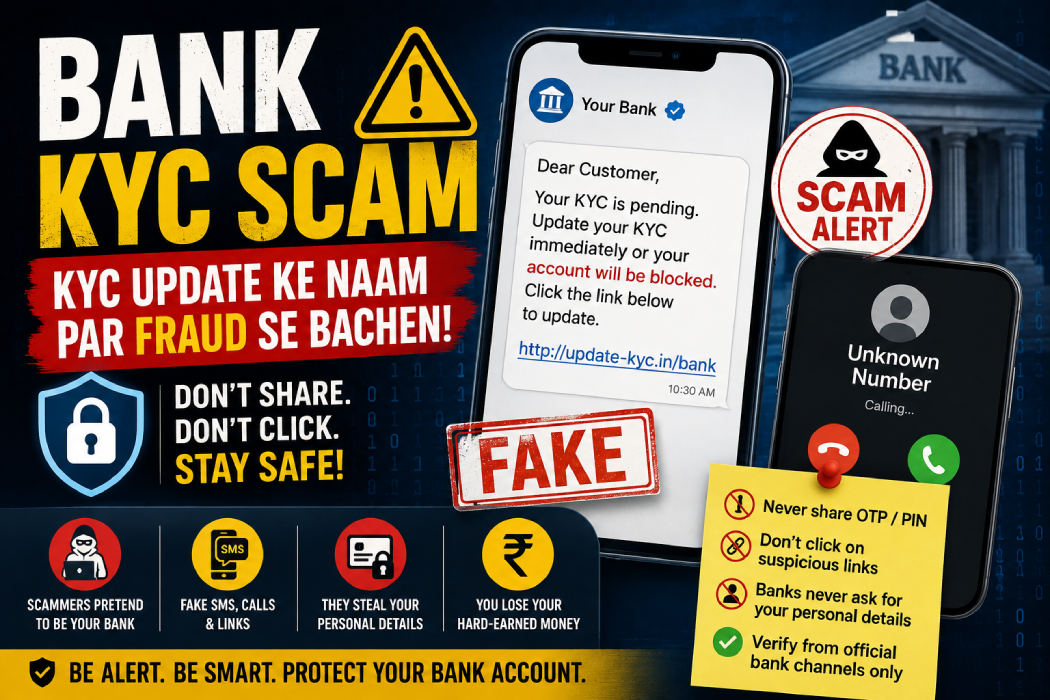
Banking has become increasingly digital in India. Customers can now check balances, transfer money, pay bills, and manage their accounts through mobile apps and internet banking. However, scammers are also using digital channels to target bank customers.
One of the common methods is the Bank KYC scam, where fraudsters pretend to be bank employees and claim that the customer’s KYC needs to be updated immediately.
The scammer may send an SMS, WhatsApp message, email, or make a phone call claiming:
“Your bank account KYC has expired. Update it immediately or your account will be blocked.”
The victim is then asked to click a link, share personal information, install an application, or make a payment.
The goal is usually to steal banking credentials, card details, OTPs, or money.
What Is a Bank KYC Scam?
A Bank KYC scam is a type of online fraud in which criminals impersonate banks or financial institutions and trick customers into providing confidential information or authorizing transactions.
KYC stands for Know Your Customer. Banks and financial institutions use KYC procedures to verify customer identity.
Scammers misuse the familiarity of the KYC process to make fraudulent messages appear legitimate.
They may tell customers that:
- Their KYC has expired
- Their account will be suspended
- Their debit card will stop working
- Their bank account will be frozen
- Their mobile banking will be disabled
- Their PAN information needs verification
- Their KYC must be completed within a few hours
The victim is then directed to a fake website, asked to call a number, or instructed to install an unknown application.
How Bank KYC Scams Work
Most KYC scams follow a simple social-engineering pattern.
Step 1: You Receive a Fake Message
The scammer sends an SMS, WhatsApp message, email, or makes a phone call.
For example:
“Your KYC is pending. Your account will be blocked today. Click here to update your KYC.”
The message may contain the bank’s name or logo to appear genuine.
Step 2: The Scammer Creates Urgency
The fraudster wants you to act without thinking.
They may claim:
- “Update within 2 hours.”
- “Your account will be blocked today.”
- “Your card will be deactivated.”
- “Complete verification immediately.”
This pressure is intentional.
Step 3: You Are Given a Link or Phone Number
The message may include a link that looks similar to a bank website.
When you open it, the page may ask for:
- Name
- Mobile number
- PAN details
- Aadhaar details
- Debit card number
- ATM PIN
- Internet banking password
- OTP
Providing such information can expose you to financial fraud.
Step 4: The Scammer May Ask for Remote Access
Some fraudsters may ask victims to download an application for “KYC verification” or “customer support.”
The application may provide remote access to the phone or expose information stored on the device.
Never install an unknown application simply because someone claiming to be a bank employee tells you to do so.
Common Types of KYC Scams
1. Fake KYC SMS Scam
You receive a message claiming that your KYC is incomplete.
The SMS contains a link such as:
“Click here to update your KYC.”
The link may lead to a fake website designed to steal your information.
2. Fake Bank Call
A scammer calls and introduces themselves as a bank representative.
They may say:
“Your KYC is incomplete. I can update it for you.”
The scammer then asks for sensitive information.
A genuine bank representative should not require you to disclose confidential authentication information such as your OTP, PIN, or password.
3. WhatsApp KYC Scam
Fraudsters may contact victims through WhatsApp using a professional-looking profile picture and bank branding.
They may send a fake KYC form or website link.
Never assume that a WhatsApp profile is genuine simply because it uses a bank logo.
4. Fake KYC App Scam
A scammer may ask you to install an APK file or another application to complete KYC verification.
This is a major warning sign.
Installing unknown applications can create security and privacy risks.
5. PAN or Aadhaar Verification Scam
The fraudster may claim that your PAN or Aadhaar details need to be updated with the bank.
They may ask you to provide copies of documents or enter details on a suspicious website.
Before sharing identity documents, verify the request directly through your bank’s official channels.
Warning Signs of a KYC Scam
Watch out for these red flags:
🚩 1. Threat of Immediate Account Blocking
A message saying your account will be blocked within minutes or hours should make you cautious.
Scammers use urgency to prevent victims from verifying the information.
🚩 2. Suspicious Link
Check the website address carefully.
A link received through SMS or WhatsApp may lead to a fake website that looks almost identical to the real bank website.
Instead of clicking the message link, open your bank’s official website or mobile application directly.
🚩 3. Request for OTP
Never share an OTP with someone who calls or messages you claiming to be a bank representative.
An OTP is intended for authentication and should remain confidential.
🚩 4. Request for ATM PIN or UPI PIN
Your ATM PIN and UPI PIN are highly sensitive.
A bank representative should not ask you to reveal your PIN.
🚩 5. Request to Install an App
Be extremely careful if someone asks you to install an unknown app for KYC, verification, customer support, or account activation.
🚩 6. Request for Payment
Be suspicious if someone tells you that you must make a payment to complete a routine KYC update.
Verify the requirement directly with your bank before making any payment.
🚩 7. Pressure to Act Immediately
Statements such as:
“Do it now.”
“Don’t disconnect the call.”
“Your account will be blocked today.”
are common social-engineering techniques.
Take time to verify the claim.
How to Protect Yourself From KYC Scams
1. Never Share Your OTP
Your OTP should be kept private.
Do not share it with anyone over:
- Phone calls
- SMS
- Social media
2. Never Share Your PIN
Never provide your:
- ATM PIN
- UPI PIN
- Internet banking password
- Card PIN
to anyone claiming to be from your bank.
3. Don’t Click Unknown KYC Links
If you receive an unexpected KYC message, don’t immediately click the link.
Instead, open your bank’s official mobile application or manually visit its official website.
4. Verify Through Official Channels
If you are unsure whether your KYC needs updating, contact your bank using the phone number listed on its official website, mobile application, bank statement, or the back of your debit card.
Do not use a phone number supplied by a suspicious SMS or WhatsApp message.
5. Don’t Install Unknown APK Files
Never install an APK or unknown application sent by an unknown person.
Legitimate banking services should be accessed through trusted and official channels.
6. Keep Your Phone Secure
Use:
- Screen lock
- Device updates
- Official app stores
- App permissions carefully
- Security software where appropriate
Avoid installing applications from unknown sources.
7. Check Your Bank Statements
Regularly review your account transactions.
If you notice an unfamiliar transaction, contact your bank immediately.
How to Check Whether a KYC Message Is Genuine
If you receive a KYC-related message, follow these steps:
Step 1: Don’t click the link.
Step 2: Don’t reply with personal information.
Step 3: Don’t share OTP or PIN.
Step 4: Open your bank’s official app manually.
Step 5: Check whether there is actually a KYC notification.
Step 6: If you’re still unsure, contact your bank through an independently verified official channel.
This simple process can prevent many KYC scams.
What If You Have Already Shared Your Details?
If you accidentally shared banking information with a suspected scammer, don’t panic—but act quickly.
Contact your bank immediately and explain what happened.
Depending on what information was exposed, you may need to:
- Block or replace your card
- Change your banking password
- Secure your mobile banking account
- Review recent transactions
- Contact your bank’s fraud department
- Take additional security measures recommended by the bank
If you shared an OTP and a transaction has occurred, report it to your bank immediately.
What If Money Has Already Been Stolen?
If you have suffered financial cyber fraud, speed is important.
Immediately contact your bank or payment provider and report the fraudulent transaction.
In India, financial cyber fraud can also be reported through the government’s official cybercrime reporting channels, including 1930 and the National Cyber Crime Reporting Portal.
Keep all relevant evidence, including:
- Transaction ID
- Amount
- Date and time
- Bank account details
- Phone numbers
- SMS messages
- WhatsApp chats
- Email messages
- Screenshots
- Suspicious website links
Do not delete the communication with the scammer because it may be useful when reporting the incident.
Bank KYC Scam: Genuine vs Fake
| Genuine Banking Communication | Possible KYC Scam |
|---|---|
| Can be verified through official channels | Comes from an unknown number |
| No request for confidential PINs | Requests OTP or PIN |
| Official banking app/website | Suspicious external link |
| No unnecessary urgency | “Update immediately or account will close” |
| Verifiable bank contact details | Random WhatsApp number |
| No unknown app installation | Asks you to install APK |
| Clear official communication | Threatening or confusing message |
Simple KYC Safety Checklist
Before responding to any KYC message, remember:
✔ Don’t click unexpected links.
✔ Never share your OTP.
✔ Never share your ATM or UPI PIN.
✔ Don’t share internet banking passwords.
✔ Don’t install unknown apps.
✔ Verify the bank through official channels.
✔ Don’t panic because of an account-blocking threat.
✔ Check transactions regularly.
✔ Report suspicious financial transactions immediately.
Final Thoughts
Bank KYC scams work because they look like legitimate banking communications.
A message containing your bank’s name, logo, or a warning about account suspension can create fear and make you act quickly. But the safest response is to stop and verify.
Never click an unexpected KYC link, never share OTPs or PINs, and never install an unknown application because someone claims it is required for bank verification.
If you genuinely need to update your KYC, use your bank’s official app, website, branch, or independently verified customer-support channel.
Remember:
Your bank account is your responsibility, but you don’t have to respond to every urgent message you receive.
When in doubt, don’t click. Verify first.
Frequently Asked Questions (FAQs)
Can a bank ask me to update my KYC?
Banks may require customers to complete or update KYC as part of regulatory and account-maintenance processes. However, customers should verify such requests through official banking channels rather than relying on unexpected links or phone numbers.
Will a bank ask for my OTP during KYC?
You should never disclose your OTP to someone who calls or messages you claiming to be a bank employee. Keep authentication credentials confidential.
How do I know if a KYC SMS is fake?
Look for warning signs such as suspicious links, urgent threats, requests for OTP or PIN, unknown phone numbers, unusual payment requests, and instructions to install unknown applications.
What should I do if I clicked a fake KYC link?
If you entered sensitive information, contact your bank immediately and follow its security instructions. If money has been transferred fraudulently, report the transaction as soon as possible through your bank and the appropriate cybercrime reporting channels.
Can scammers steal money through a fake KYC call?
Yes. Scammers may use information obtained through fake KYC calls to attempt unauthorized transactions or further fraud. Never share your PIN, OTP, password, or other confidential banking credentials with callers.