

Online shopping and home delivery have become a normal part of everyday life. From groceries and clothes to electronics and documents, people regularly receive packages from courier and delivery companies.
Unfortunately, scammers are using this familiarity to create fake delivery and courier scams.
In these scams, fraudsters pretend to be delivery executives, courier company representatives, customs officers, or customer-support agents. They may claim that a parcel is stuck, an address needs verification, a delivery fee is pending, or a package requires a small payment.
The victim is then asked to click a link, scan a QR code, make a payment, share an OTP, or install an unknown application.
What appears to be a small delivery issue can eventually lead to financial loss or theft of sensitive personal information.
What Is a Fake Delivery Scam?
A fake delivery scam is an online fraud in which scammers impersonate a courier or delivery service to trick people into giving away money or confidential information.
The scammer may contact you through:
- Phone calls
- SMS
- Social media
- Fake courier websites
- Messaging applications
They may use the name or logo of a well-known courier company to make their communication look genuine.
Common excuses include:
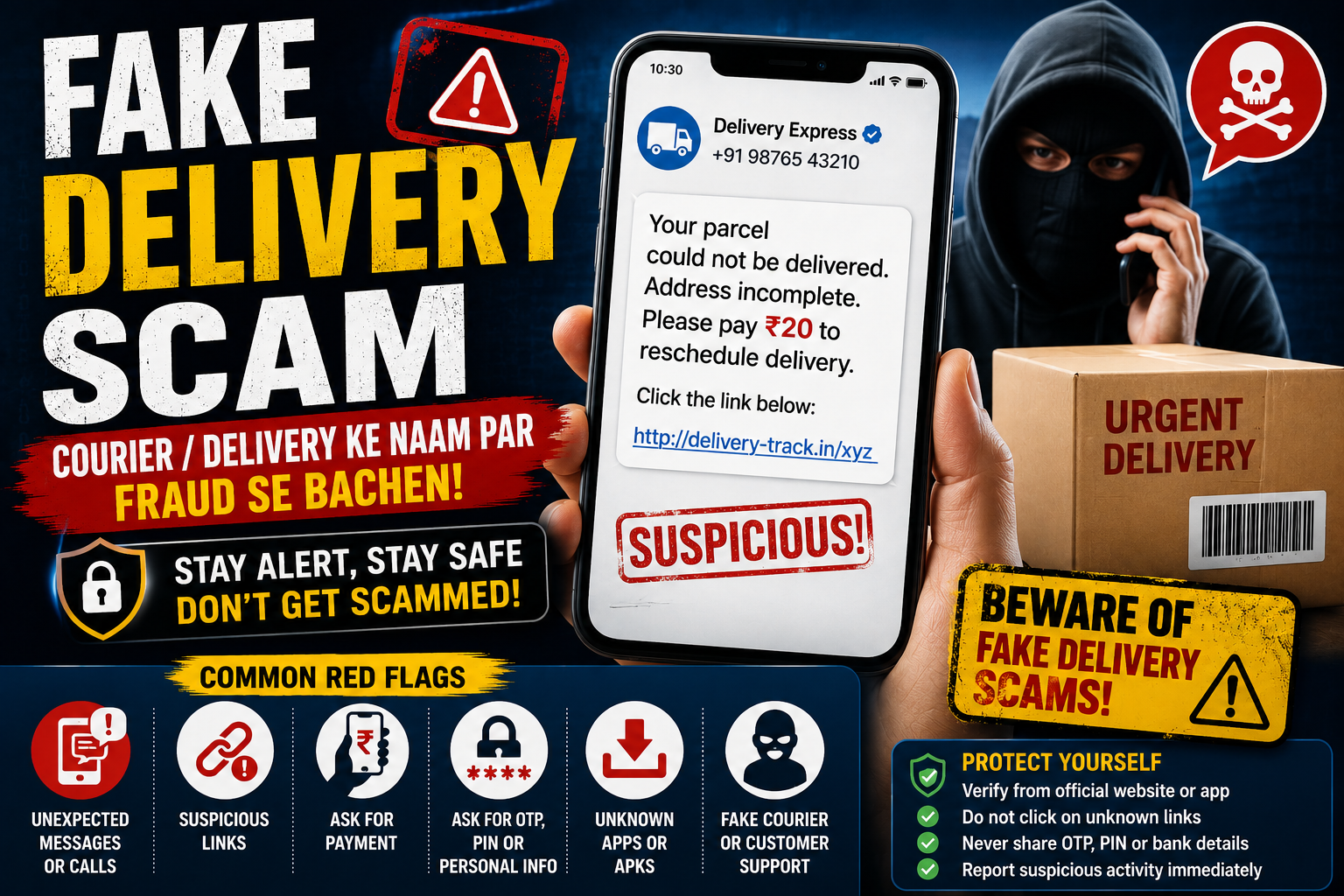
- “Your parcel could not be delivered.”
- “Your address is incomplete.”
- “Pay ₹20 to reschedule delivery.”
- “Your parcel is stuck at customs.”
- “Your delivery fee is pending.”
- “Verify your address immediately.”
- “Pay a small charge to release your package.”
The ultimate goal is to make the victim transfer money or provide information that can be used for further fraud.
How Fake Delivery Scams Work
These scams often follow a simple process.
Step 1: You Receive an Unexpected Message
You may receive an SMS or WhatsApp message saying:
“Your package could not be delivered because your address is incomplete. Click here to update your details.”
The message may contain a link.
The scammer hopes that you will click it without checking whether you are actually expecting a package.
Step 2: The Scammer Creates Urgency
The message may say:
- “Your parcel will be returned today.”
- “Complete verification within 30 minutes.”
- “Pay immediately to avoid cancellation.”
- “Your package is being held.”
The purpose is to make you panic and act quickly.
Step 3: You Are Asked to Pay a Small Amount
The scammer may request a small payment such as a delivery fee, rescheduling charge, or address-verification fee.
Because the amount appears small, the victim may not suspect fraud.
However, the payment page could be fake, or the scammer may use the transaction to collect sensitive information.
Step 4: Your Information May Be Requested
A fake delivery website may ask for:
- Name
- Mobile number
- Address
- Card details
- Banking information
- OTP
- Other personal information
Never provide sensitive financial information simply because a message claims to be related to a parcel.
Common Types of Fake Delivery Scams
1. Fake Delivery SMS Scam
This is one of the simplest methods.
You receive a message claiming that a parcel is waiting for delivery.
The message contains a link to “track,” “verify,” or “reschedule” the package.
The link may lead to a fraudulent website.
2. Fake Courier Call
A scammer may call and say:
“I am calling from the courier company. Your parcel cannot be delivered because of an address problem.”
They may ask you to confirm personal information or make a payment.
If you are not expecting a package, don’t provide any information.
3. Small Delivery Fee Scam
The scammer may say that your package requires a small payment for delivery.
For example:
“Pay ₹25 to complete delivery.”
The small amount is intended to make the request appear harmless.
However, the payment page may be fraudulent or designed to collect sensitive information.
4. Fake Customs Scam
A scammer may claim that an international parcel has been stopped by customs.
They may demand money for:
- Customs clearance
- Tax
- Import charges
- Penalty
- Documentation
They may threaten that the package will be destroyed or returned if payment isn’t made immediately.
Always independently verify such claims.
5. Fake Parcel Containing Illegal Items
This is a more frightening version of the scam.
The fraudster may claim that a parcel linked to your name contains illegal or suspicious items.
They may pretend to be from a courier company, police department, customs authority, or another official organization.
The scammer then demands money to “resolve” the issue.
This is designed to scare the victim into making a quick payment.
6. Fake Delivery App or APK Scam
Some scammers may ask you to install an application to track or confirm a delivery.
They may send an APK file through WhatsApp or another messaging platform.
Installing unknown applications can expose your phone and personal information to serious security risks.
Avoid installing apps from unknown sources.
Warning Signs of a Fake Delivery Scam
Knowing the red flags can help you identify these scams quickly.
🚩 1. You Are Not Expecting Any Parcel
If you haven’t ordered anything and suddenly receive a delivery message, don’t assume it is genuine.
Verify the package independently.
🚩 2. Suspicious Link
Be cautious of links sent through unexpected SMS or WhatsApp messages.
Instead of clicking the link, open the shopping or courier company’s official app or website manually.
🚩 3. Urgent Payment Request
Messages such as:
“Pay now or your parcel will be cancelled.”
or
“Your parcel will be returned within one hour.”
should immediately raise suspicion.
🚩 4. Very Small Payment
Scammers may ask for a tiny amount to make the request seem believable.
A small payment request does not automatically mean the message is legitimate.
🚩 5. Request for OTP
Never share an OTP with a person who contacts you unexpectedly about a delivery.
🚩 6. Request for Card or Banking Details
A suspicious delivery message asking for complete card details, PINs, passwords, or banking credentials should be treated as a major warning sign.
🚩 7. Unknown APK or App
Never install an unknown application simply because a person claiming to be a delivery agent asks you to do so.
🚩 8. Threats and Fear
Scammers may threaten you with:
- Legal action
- Police complaints
- Parcel seizure
- Customs penalties
- Account suspension
These tactics are designed to create panic.
How to Verify a Delivery Message
If you receive an unexpected delivery message, don’t immediately click anything.
Follow these steps.
Step 1: Check Your Orders
Open the shopping apps or websites where you actually placed orders.
Check whether you have a package currently in transit.
Step 2: Check the Tracking Number
If the message provides a tracking number, verify it independently on the courier company’s official website.
Don’t rely only on the link supplied in the SMS.
Step 3: Contact the Company Directly
If you’re still unsure, use the official customer-support information available on the company’s genuine website or app.
Don’t call a phone number provided in a suspicious message.
Step 4: Don’t Make an Immediate Payment
Take time to verify the reason for the payment.
A scammer wants you to act before you investigate.
How to Protect Yourself From Fake Delivery Scams
1. Don’t Click Unexpected Links
Avoid clicking links in unsolicited delivery messages.
If you need to track a package, open the retailer or courier website yourself.
2. Never Share OTPs
An OTP should remain confidential.
Don’t share it with delivery agents, callers, or people claiming to represent a courier company.
3. Don’t Share Your UPI PIN
Your UPI PIN should never be shared with anyone.
If someone asks you to enter your PIN to receive a refund or delivery confirmation, stop and verify the transaction.
4. Don’t Scan Unknown QR Codes
A scammer may send a QR code claiming it is required to receive a refund or complete delivery.
Always check what transaction you are authorizing before entering your UPI PIN.
5. Don’t Install Unknown Apps
Avoid installing APK files or applications sent through unknown messages.
Use trusted app stores and official company applications.
6. Check Your Bank Transactions
Regularly monitor your bank account and payment-app transaction history.
Report unfamiliar transactions immediately.
7. Don’t Trust Caller ID Alone
A phone number or caller ID does not prove that the caller is a genuine courier representative.
Verify the information through an independent official channel.
What If You Accidentally Paid a Fake Delivery Scammer?
If you realize that you have made a payment to a scammer, act immediately.
Contact Your Bank
Inform your bank or payment provider about the fraudulent transaction as soon as possible.
Provide details such as:
- Transaction ID
- Amount
- Date and time
- UPI ID or payment details
- Screenshots
- Recipient information
Report the Cyber Fraud
In India, suspected financial cyber fraud can be reported through the official cybercrime reporting system, including the 1930 cybercrime helpline.
The sooner a fraudulent transaction is reported, the sooner appropriate action can potentially be initiated.
Preserve the Evidence
Don’t delete:
- SMS messages
- WhatsApp conversations
- Emails
- Phone numbers
- Payment screenshots
- Tracking details
- Suspicious links
- Fake courier websites
These records may be useful when reporting the incident.
What If You Shared Your Card or Banking Details?
If you provided sensitive financial information to a suspected scammer, contact your bank immediately.
Depending on what information was exposed, you may need to:
- Block your card
- Change relevant passwords
- Secure your banking account
- Monitor transactions
- Contact the bank’s fraud department
- Follow the bank’s recommended security steps
If you installed a suspicious application, consider removing it and reviewing the permissions it was given. If you believe your device or accounts have been compromised, seek help through the relevant official service provider.
Fake Delivery Scam vs Genuine Delivery Message
| Genuine Delivery Communication | Possible Fake Delivery Scam |
|---|---|
| Can be verified through the official app | Unexpected message with a link |
| Tracking details can be independently checked | Tracking information cannot be verified |
| No unnecessary pressure | “Pay immediately” threats |
| Official company channels | Unknown phone numbers |
| Clear order information | No order or parcel details |
| Normal delivery process | Unusual payment request |
| No request for OTP/PIN | Requests confidential information |
| No unknown app installation | Sends APK or suspicious app |
10 Rules to Stay Safe
Remember these simple rules whenever you receive a delivery message:
1. Check whether you actually ordered a package.
2. Don’t click unexpected delivery links.
3. Verify tracking information independently.
4. Never share OTPs.
5. Never share UPI PINs or card PINs.
6. Don’t scan unknown QR codes.
7. Don’t install unknown delivery apps or APK files.
8. Don’t make payments because of threats or pressure.
9. Contact the courier or shopping company through official channels.
10. Report fraudulent transactions immediately.
Final Thoughts
Fake delivery scams work because they take advantage of something most people are familiar with: receiving online orders.
A simple message saying “Your parcel is delayed” or “Pay ₹20 to complete delivery” may look harmless. But clicking an unknown link, sharing an OTP, entering card details, or approving a payment can expose you to financial fraud.
The safest approach is to stop, verify, and then act.
If you are expecting a package, check its status directly through the retailer or courier company’s official app or website. If you’re not expecting anything, be even more cautious.
Remember:
A delivery message should never pressure you into sharing confidential banking information.
When in doubt, don’t click the link. Verify the delivery independently.
A few seconds of caution can protect your money, personal information, and digital identity from a fake delivery scam.
Frequently Asked Questions (FAQs)
How do fake delivery scams work?
Scammers pretend to be courier or delivery representatives and claim that a parcel requires payment, address verification, or some other action. They may then send fraudulent links, request sensitive information, or ask victims to transfer money.
What should I do if I receive a delivery SMS with a link?
Don’t click the link immediately. Check your actual orders through the retailer’s official app or website. If necessary, verify the tracking number independently through the courier company’s official website.
Can a delivery scammer steal money through a QR code?
A scammer may use a QR code to trick you into making a payment. Always check the transaction details before approving a UPI payment and never enter your UPI PIN simply because someone says you need to receive a parcel or refund.
Should I pay a small fee to reschedule a delivery?
Don’t make the payment simply because you received an unexpected message. Verify the delivery through the official retailer or courier service first.
What should I do if I paid a fake courier?
Contact your bank or payment provider immediately, report the suspected financial fraud through the appropriate official cybercrime channels, and preserve all messages, payment details, phone numbers, and screenshots related to the scam.