

Online shopping has become a convenient part of everyday life. From clothes and smartphones to electronics, furniture, beauty products, and groceries, almost everything can now be purchased online.
But with the growth of online shopping, fake shopping websites have also become a serious problem.
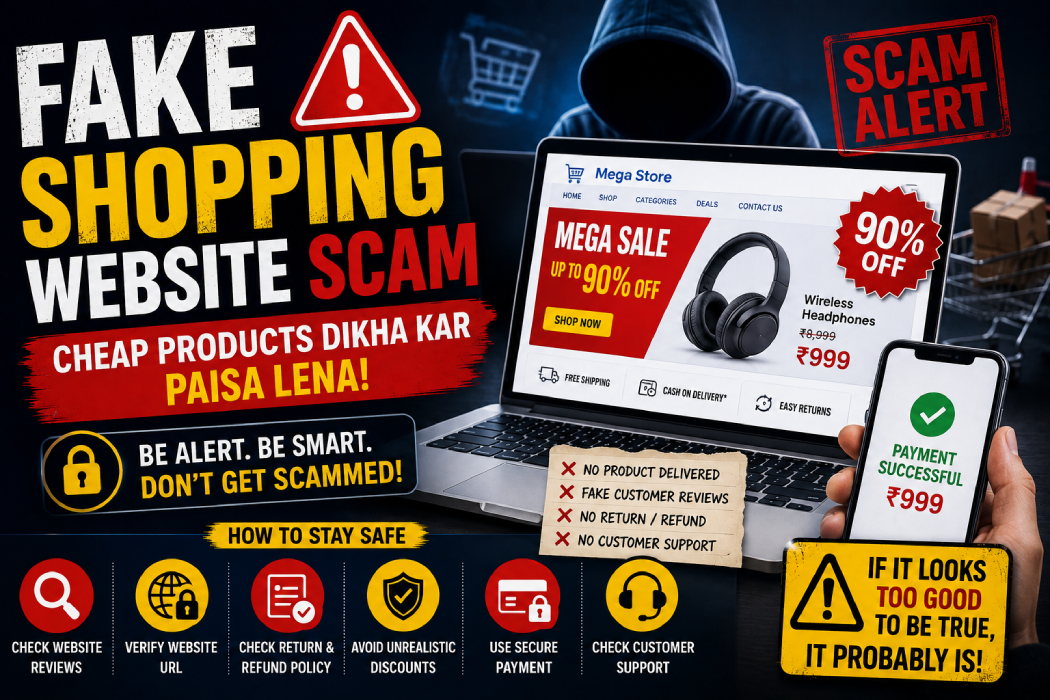
Scammers create websites that look like genuine online stores and advertise products at extremely low prices. The attractive discounts encourage shoppers to place orders and make payments. After receiving the money, the scammer may never deliver the product.
In some cases, fake shopping websites can also be designed to collect customers’ personal and financial information.
The good news is that you can avoid many of these scams by learning how to identify suspicious websites before making a payment.
What Is a Fake Shopping Website Scam?
A fake shopping website scam happens when criminals create a fraudulent online store to trick customers into paying for products that may never be delivered.
The website may look professional and include:
- Product photos
- Customer reviews
- Discount offers
- Shopping categories
- Contact information
- Payment options
- Fake company details
- Fake order-tracking pages
Some websites even copy the design and branding style of legitimate shopping platforms.
The main attraction is usually an unusually low price.
For example, a product normally priced at ₹20,000 might be advertised for ₹6,999 with a message such as:
“Limited-time offer — only 3 pieces left!”
This combination of a huge discount and urgency is designed to make shoppers purchase without properly checking the website.
How Fake Shopping Website Scams Work
Most fake shopping scams follow a similar process.
Step 1: You See an Attractive Advertisement
The scam may begin with an advertisement on social media, search engines, messaging apps, or another website.
The advertisement may offer:
- 70%–90% discounts
- Clearance sales
- Limited-stock deals
- Festival offers
- Flash sales
- Premium products at extremely low prices
The advertisement takes you to a shopping website.
Step 2: The Website Looks Genuine
The fake website may contain professional product images, categories, banners, reviews, and an attractive design.
This creates the impression that you are shopping from a legitimate online store.
However, a professional-looking website does not automatically mean the business is genuine.
Step 3: You Find an Unusually Cheap Product
The website may offer expensive products at prices that seem too good to be true.
For example:
Premium smartphone — ₹49,999 → ₹14,999
Branded shoes — ₹8,000 → ₹1,499
Laptop — ₹70,000 → ₹29,999
Such offers can encourage customers to ignore warning signs.
Step 4: You Place the Order
You add the product to your cart and enter information such as:
- Name
- Phone number
- Address
- Email address
The website may then ask you to make an online payment.
Step 5: The Product Never Arrives
After receiving the payment, the scammer may:
- Never ship the product
- Send a completely different item
- Send a low-value product
- Provide fake tracking information
- Stop responding to messages
In some cases, the website may disappear completely after collecting money from customers.
Common Types of Fake Shopping Scams
1. Huge Discount Scam
The website offers expensive products at extremely low prices.
A massive discount should make you investigate the seller before purchasing.
2. Social Media Shopping Scam
Fake stores can advertise heavily on platforms such as Instagram and Facebook.
A professional advertisement does not guarantee that the seller is genuine.
Always verify the store independently before paying.
3. Fake Festival Sale
Scammers may create websites around popular shopping periods and festivals.
They may use phrases such as:
- “Festival Mega Sale”
- “Diwali Clearance”
- “Independence Day Sale”
- “Limited Stock”
- “Midnight Sale”
The purpose is to create urgency.
4. Fake Brand Website
Some scammers create websites that imitate well-known brands.
The website may use similar colors, product images, logos, and layouts.
Always check the website address carefully and visit the brand’s official website directly when possible.
5. Fake Clearance Sale
A website may claim that a store is closing down and everything must be sold immediately.
The products may be advertised at extremely low prices.
This is often used to convince shoppers that an unrealistic discount has a legitimate explanation.
Warning Signs of a Fake Shopping Website
Knowing the red flags can help you avoid losing money.
🚩 1. The Price Is Too Good to Be True
This is one of the biggest warning signs.
If a product is dramatically cheaper than its normal market price, don’t immediately assume you’ve found a great deal.
Compare the price with established retailers and the manufacturer’s official website.
🚩 2. Recently Created or Suspicious Website
A website with little online presence, no reliable reviews, or a suspicious domain deserves extra caution.
Search for independent information about the seller before purchasing.
🚩 3. No Proper Contact Information
Be careful if the website doesn’t provide:
- Physical business information
- Working customer support
- Clear return policy
- Refund information
- Terms and conditions
A simple contact form is not enough to prove that a store is genuine.
🚩 4. Poorly Written Content
Fake shopping websites sometimes contain:
- Grammar mistakes
- Strange sentences
- Poor translations
- Incorrect product descriptions
- Inconsistent company information
One mistake doesn’t prove a website is fraudulent, but several such signs together should make you cautious.
🚩 5. Fake-Looking Reviews
Some fake websites display hundreds of perfect five-star reviews.
Look for independent reviews outside the website itself.
Don’t rely only on testimonials published by the seller.
🚩 6. Only Prepaid Payment
Be cautious when a new or unfamiliar website accepts only advance payment and provides no reasonable alternative.
The absence of cash-on-delivery alone does not prove fraud, but combined with other warning signs it should increase your caution.
🚩 7. Pressure to Buy Immediately
Messages such as:
“Only 2 items left!”
“Offer expires in 10 minutes!”
“Last chance!”
are designed to encourage impulse purchases.
Take a few minutes to verify the seller before paying.
🚩 8. Suspicious Website Address
Check the domain name carefully.
Scammers may use domain names that resemble legitimate businesses but contain additional words, unusual characters, or spelling changes.
How to Check Whether an Online Store Is Genuine
Before buying from an unfamiliar website, follow these steps.
1. Search for the Website
Search the store’s name along with terms such as:
“reviews”
“complaints”
“scam”
“customer experience”
Look for information from independent sources.
2. Check the Website Address
Look carefully at the domain name.
Don’t assume a website is genuine simply because it uses HTTPS. HTTPS encrypts the connection, but it does not guarantee that the business itself is legitimate.
3. Check the Return and Refund Policy
A genuine online store should normally provide clear information about:
- Returns
- Refunds
- Shipping
- Cancellations
- Customer support
Read these policies before placing an order.
4. Verify the Business Information
Look for information about the company or seller.
If the website claims to represent an established brand, visit that brand’s official website separately and verify whether the store is an authorized seller.
5. Compare Prices
Check the same product on multiple established shopping platforms.
If one unknown website is selling the product at a dramatically lower price than everyone else, investigate carefully.
6. Check Independent Reviews
Don’t rely only on reviews displayed on the shopping website.
Look for independent customer experiences.
How to Stay Safe While Shopping Online
Use Trusted Shopping Platforms
Whenever possible, purchase from established retailers or directly from a brand’s official website.
Avoid Random Links
Don’t purchase expensive products simply because someone sends you a shopping link through WhatsApp, Telegram, SMS, or social media.
Open the website independently and verify it.
Don’t Share Unnecessary Information
Only provide information that is genuinely required to complete a purchase.
Never share:
- UPI PIN
- ATM PIN
- Banking password
- OTP with another person
- Card PIN
Be Careful With Payment Requests
Before completing a UPI transaction, carefully check the recipient and amount.
Remember that entering your UPI PIN authorizes a payment.
Keep Transaction Records
Save:
- Order confirmation
- Invoice
- Payment receipt
- Seller information
- Emails
- Messages
- Screenshots
These can be useful if something goes wrong.
What If You Have Already Paid a Fake Shopping Website?
If you believe you have been scammed, act quickly.
Step 1: Contact Your Bank or Payment Provider
Report the transaction as soon as possible.
Provide the transaction ID, amount, date, payment method, and other available information.
Step 2: Report Financial Cyber Fraud
In India, suspected financial cyber fraud can be reported through the official cybercrime reporting system, including the 1930 cybercrime helpline.
Quick reporting is important because financial institutions may have processes for attempting to stop or trace fraudulent transactions.
Step 3: Save All Evidence
Keep copies of:
- Website URL
- Product page
- Order confirmation
- Payment screenshot
- Transaction ID
- Emails
- WhatsApp messages
- Phone numbers
- Advertisement screenshots
Don’t delete the communication.
Step 4: Contact the Payment Provider
If you paid through a card, UPI, or another payment method, contact the relevant payment provider and explain that the transaction is suspected fraud.
Follow the security and dispute instructions they provide.
Fake Shopping Website vs Genuine Website
| Genuine Shopping Website | Possible Fake Shopping Website |
|---|---|
| Verifiable company information | Business information is unclear |
| Reasonable pricing | Unrealistic discounts |
| Clear return/refund policy | Missing or copied policies |
| Independent customer reviews | Only perfect reviews on its own site |
| Reliable customer support | No response or suspicious contact |
| Secure and recognizable checkout | Unusual payment process |
| Established online presence | Little or no independent presence |
| Clear product information | Poor or inconsistent descriptions |
10 Rules to Avoid Shopping Scams
Remember these simple rules before purchasing from an unfamiliar website:
1. Don’t trust extremely cheap prices immediately.
2. Research the website before buying.
3. Check the domain name carefully.
4. Look for independent customer reviews.
5. Verify the seller’s contact information.
6. Read the return and refund policy.
7. Avoid clicking random shopping links.
8. Never share your OTP, UPI PIN, or card PIN.
9. Save payment and order records.
10. Report suspected fraud quickly.
Final Thoughts
Fake shopping websites are designed to look convincing. Attractive product photos, huge discounts, fake reviews, countdown timers, and professional-looking designs can make a fraudulent store appear legitimate.
The biggest mistake is allowing an attractive price to replace proper verification.
Before purchasing from an unfamiliar online store, research the seller, compare prices, check independent reviews, verify the website, and understand the refund policy.
If something feels suspicious, don’t rush.
Remember:
A great deal isn’t a great deal if you never receive the product.
Take a few minutes to verify the website before making a payment. That small step can protect your money and personal information from an online shopping scam.
Frequently Asked Questions (FAQs)
How can I identify a fake shopping website?
Look for unrealistic discounts, unclear business information, suspicious domain names, poor website content, missing refund policies, fake-looking reviews, and pressure to make an immediate payment.
Is HTTPS enough to prove that an online store is safe?
No. HTTPS helps protect the connection between your browser and the website, but it does not prove that the website or seller is legitimate.
What should I do if I paid a fake shopping website?
Contact your bank or payment provider immediately, preserve all transaction and communication records, and report suspected financial cyber fraud through the appropriate official channels.
Can a fake shopping website steal my card details?
A fraudulent website may attempt to collect financial or personal information. Avoid entering sensitive information on unfamiliar websites unless you have independently verified the seller.
Are very cheap online products always a scam?
No. Genuine stores can offer discounts and promotions. However, an unusually large discount from an unfamiliar seller is a reason to investigate before purchasing.
Should I trust shopping websites shared through WhatsApp?
Don’t automatically trust them. Independently verify the seller and website before making a payment, especially when the offer promises an unusually large discount.