

Credit and debit cards have made online shopping, bill payments, travel bookings, and everyday purchases much easier. But as digital payments have grown, scammers have also developed new ways to trick card users.
One of the most common methods is the Credit/Debit Card Scam, where fraudsters pretend to be bank representatives, customer-care agents, merchants, or other trusted organizations and try to obtain sensitive card information.
They may ask for your card number, CVV, expiry date, OTP, PIN, or other confidential information.
Sometimes, scammers don’t even need to hack your bank account. They simply manipulate you into sharing information or approving a transaction yourself.
The good news is that most card scams can be avoided by following a few basic security rules.
What Is a Credit/Debit Card Scam?
A credit or debit card scam is a type of financial fraud where criminals try to obtain card information or convince victims to authorize unauthorized transactions.
Scammers may contact you through:
- Phone calls
- SMS
- Social media
- Fake websites
- Fake customer-care numbers
- Messaging applications
They may pretend to represent your bank or another trusted organization.
For example, a scammer might say:
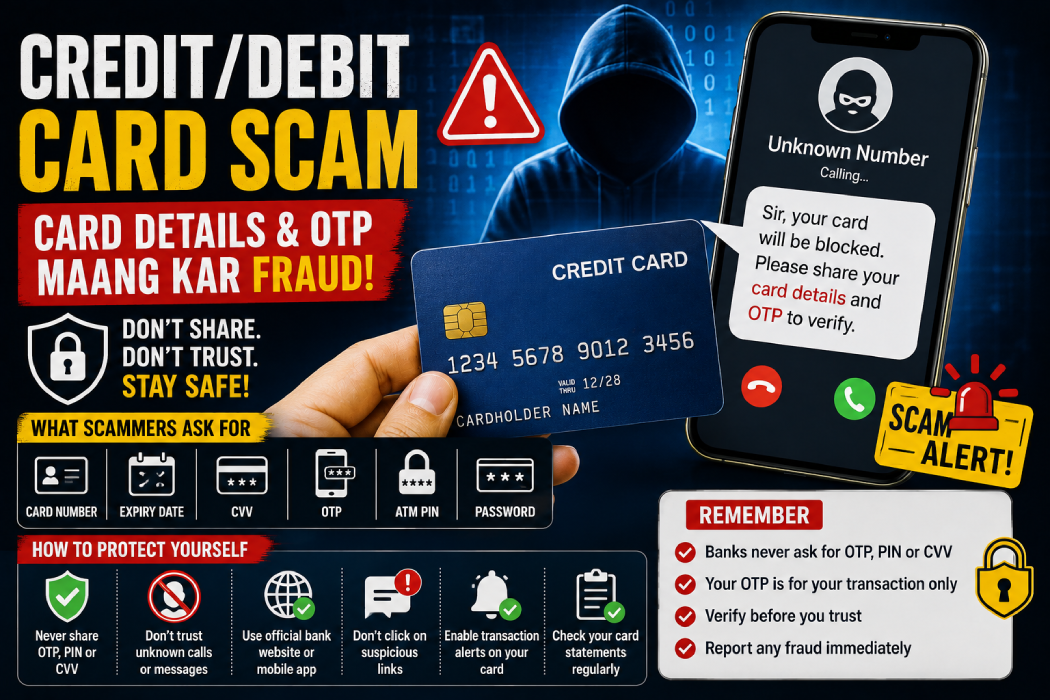
“Your card will be blocked unless you complete verification.”
They may then ask you to provide your card details and OTP.
The information can potentially be used to make unauthorized transactions.
How Credit/Debit Card Scams Work
Most card scams use social engineering rather than complicated hacking.
Step 1: The Scammer Contacts You
The fraudster may introduce themselves as:
- A bank employee
- Customer-care executive
- Insurance representative
- Delivery agent
- Shopping website representative
- Government official
They may already know your name or some basic information, making the conversation sound convincing.
Step 2: They Create a Problem
The scammer may claim:
- Your card is about to expire
- Your card has been blocked
- Your KYC is incomplete
- A suspicious transaction was detected
- Your reward points are expiring
- Your card upgrade is pending
- Your refund is waiting
The purpose is to make you worried or excited.
Step 3: They Ask for Card Information
The scammer may ask for:
- Card number
- Expiry date
- CVV
- OTP
- ATM PIN
- Internet banking password
This is a major warning sign.
Never share your card PIN or OTP with an unsolicited caller.
Step 4: They May Ask You to Approve an OTP
The scammer may say:
“You will receive an OTP. Tell me the OTP so I can complete the verification.”
But the OTP may actually be authorizing a transaction.
If you share it, the scammer may be able to complete the fraudulent transaction.
Common Credit/Debit Card Scams
1. Fake Bank Customer-Care Scam
A scammer pretends to be a bank customer-care representative.
They may tell you that there is a problem with your card and ask you to “verify” your information.
The safest approach is to end the call and contact your bank using an official number obtained independently.
2. Card Blocking Scam
You may receive a message saying:
“Your debit card will be blocked today. Call this number immediately.”
The number may connect you to a fake bank representative.
The scammer then asks for card details or an OTP.
Don’t panic because of such messages. Verify the information directly through your bank’s official channels.
3. Fake KYC Verification
This scam is similar to a bank KYC scam.
The fraudster claims that your KYC is incomplete and your card or bank account will be suspended.
You may be asked to provide card details, OTPs, or personal information.
Never share confidential banking credentials with someone who contacts you unexpectedly.
4. Reward Points Scam
Scammers may claim that you have earned reward points and that they are about to expire.
They may send a link asking you to redeem the points.
The website may be fake and designed to collect your card information.
If you receive a reward-related message, check your rewards directly through your bank’s official app or website.
5. Fake Refund Scam
A scammer may claim that you are eligible for a refund.
They may ask for your card details or send a payment link.
Be particularly careful if someone says you must provide an OTP or card PIN to receive a refund.
Verify refunds directly with the merchant or bank.
6. Fake Shopping Website Scam
Fraudulent shopping websites may collect card information during checkout.
The website may look professional but may not be a genuine business.
Before entering payment information, verify the website and seller independently.
7. Fake Insurance or Investment Calls
Fraudsters may claim that they represent an insurance company or investment service.
They may request card information for a supposed payment, refund, or verification.
Always verify the company independently before sharing any financial information.
Warning Signs of a Card Scam
Watch for these red flags:
🚩 Someone Asks for Your OTP
An OTP should remain confidential.
If an unsolicited caller asks you to read out an OTP, don’t share it.
🚩 Someone Asks for Your ATM PIN
Never disclose your ATM PIN to another person.
Your bank will not need you to reveal your PIN to a caller for routine assistance.
🚩 Someone Asks for Your CVV
Be cautious when someone unexpectedly asks for your CVV.
Don’t provide sensitive card information to an unsolicited caller.
🚩 Immediate Account Blocking Threat
Scammers often use fear.
For example:
“Your account will be blocked in 10 minutes.”
Take a moment to verify the claim through your bank’s official app or customer-care channel.
🚩 Unexpected Reward or Refund
If someone suddenly tells you that you’ve won a reward or are receiving a refund, verify the information independently.
🚩 Suspicious Link
Don’t click links from unexpected messages claiming to be from your bank.
Instead, open your bank’s official website or mobile app yourself.
🚩 Request to Install an App
Never install an unknown application because someone claims it is required for card verification or customer support.
What Information Should Never Be Shared?
Protect your financial credentials carefully.
Never share your:
- ATM PIN
- UPI PIN
- OTP
- Internet banking password
- Card PIN
- CVV with unsolicited callers
- Complete card details with unknown persons
Also be careful when entering card information on unfamiliar websites.
Remember: Your OTP Is Private
An OTP is designed to verify or authorize a transaction.
If someone calls you and asks:
“Please tell me the OTP you just received.”
Stop the conversation.
The OTP could be related to a transaction that the scammer is trying to complete.
How to Protect Your Credit and Debit Cards
1. Never Share Your PIN
Keep your ATM and card PIN confidential.
Don’t write it on the card or share it with anyone.
2. Never Share OTPs
Banks and legitimate services should not require you to disclose an OTP to an unsolicited caller.
3. Use Official Banking Apps
For checking transactions, card status, rewards, or account information, use your bank’s official application or website.
4. Don’t Trust Caller ID
A phone number appearing to belong to a bank does not automatically prove that the caller is genuine.
Scammers can use techniques that make calls appear more trustworthy.
5. Don’t Click Suspicious Links
Avoid links received through unexpected SMS, WhatsApp, email, or social media messages.
If you need to access your bank account, open the official app yourself.
6. Turn on Transaction Alerts
Enable SMS, email, or app notifications for transactions where available.
This can help you identify suspicious activity quickly.
7. Check Your Bank Statements
Regularly review your account and card transactions.
Report unfamiliar transactions to your bank immediately.
8. Be Careful With Public Wi-Fi
Avoid performing sensitive banking transactions on unsecured public networks whenever possible.
9. Don’t Save Card Details Everywhere
Only save card information on services and websites you trust.
For unfamiliar websites, consider avoiding stored payment information.
What Should You Do If Your Card Details Are Compromised?
If you believe your card information has been exposed, don’t wait for an unauthorized transaction to happen.
Contact your bank immediately.
Depending on the circumstances, your bank may recommend:
- Blocking the card
- Temporarily disabling transactions
- Replacing the card
- Changing relevant credentials
- Reviewing recent transactions
- Taking additional security measures
If you see an unauthorized transaction, report it to your bank immediately and follow its fraud-reporting process.
What If Money Has Already Been Stolen?
If you have already suffered financial fraud, act quickly.
Step 1: Contact Your Bank
Report the unauthorized transaction immediately.
Provide:
- Transaction amount
- Date and time
- Transaction reference number
- Merchant information
- Screenshots
- Relevant SMS or emails
Step 2: Report Cyber Fraud
In India, suspected financial cyber fraud can be reported through the official cybercrime reporting system, including the 1930 cybercrime helpline.
The sooner you report the incident, the sooner appropriate action can potentially be initiated.
Step 3: Preserve Evidence
Keep:
- Call records
- Phone numbers
- SMS messages
- WhatsApp conversations
- Emails
- Payment screenshots
- Transaction IDs
- Website links
Don’t delete evidence related to the scam.
Credit/Debit Card Scam vs Safe Banking Practice
| Safe Banking Practice | Possible Scam |
|---|---|
| You contact the bank yourself | Unexpected call from “bank employee” |
| You use the official banking app | Random link sent by SMS |
| OTP remains private | Caller asks for OTP |
| PIN remains confidential | Caller asks for PIN |
| Transactions are verified | Urgent payment request |
| Rewards checked through official app | Unexpected reward link |
| Refund verified with merchant | Caller asks for card details |
| Card is blocked through official channels | Caller demands immediate action |
10 Rules to Stay Safe From Card Scams
Keep these simple rules in mind:
1. Never share your OTP.
2. Never share your ATM or card PIN.
3. Don’t give sensitive card information to unsolicited callers.
4. Don’t click suspicious banking links.
5. Use your bank’s official app or website.
6. Don’t install unknown applications.
7. Don’t trust unexpected reward or refund messages.
8. Check transactions regularly.
9. Report unauthorized transactions immediately.
10. When in doubt, contact your bank directly.
Final Thoughts
Credit and debit card scams often succeed because fraudsters create fear, urgency, or excitement.
A caller may claim that your card is being blocked. A message may promise a reward. Another scammer may offer a refund. In each case, the goal is to make you act before you have time to verify the information.
The safest approach is simple:
Stop. Don’t share confidential information. Verify independently.
Never share your OTP, PIN, or banking password with someone who contacts you unexpectedly. If you receive a suspicious message or call, contact your bank through an official channel instead of using the contact information provided by the caller.
Remember:
Your bank will never need you to reveal your secret PIN or OTP to prove that you are the account holder.
A few seconds of caution can protect your money from a potentially expensive credit or debit card scam.
Frequently Asked Questions (FAQs)
Can someone steal money using only my card number?
Card fraud can involve different types of information, and the risk depends on what details have been exposed and the transaction involved. If you believe your card information has been compromised, contact your bank immediately.
Should I share an OTP with a bank representative?
Do not disclose an OTP to an unsolicited caller claiming to be from your bank. Treat requests for OTPs as a major warning sign.
Can a bank employee ask for my ATM PIN?
You should never disclose your ATM PIN to a caller or anyone claiming to provide customer support.
What should I do if I accidentally shared my card details?
Contact your bank immediately and explain what information was shared. Follow the bank’s recommendations, which may include blocking or replacing the card and monitoring transactions.
What should I do if I see an unauthorized card transaction?
Contact your bank immediately, report the transaction as unauthorized, and follow the bank’s fraud-reporting procedure. If you suspect cyber fraud, you can also report it through India’s official cybercrime reporting channels.
Are reward-point messages always scams?
No. Banks do send genuine reward-related communications. However, don’t click unexpected links or share confidential information. Check your rewards directly through your bank’s official app or website.