

Introduction
Artificial Intelligence has evolved at an incredible pace over the past few years. What started as simple chatbots and automation tools has now grown into intelligent AI assistants capable of writing content, generating images, analyzing data, coding software, and even making business decisions.
In 2026, AI is no longer considered an experimental technology—it has become a core part of everyday life. Businesses rely on AI for customer support, marketers use it to create content, developers write code with AI assistance, and students use AI-powered research tools to improve productivity.
As we move toward 2027, the next wave of innovation is already taking shape. AI models are becoming more capable, multimodal systems are improving rapidly, and autonomous AI agents are beginning to handle complex workflows with minimal human supervision. Governments are also introducing regulations, while companies continue investing billions in AI infrastructure.
This article explores the biggest AI trends expected to shape 2027. These predictions are based on current technological developments rather than speculation, helping businesses, professionals, and creators prepare for what’s next.
Why 2027 Could Be a Turning Point for AI
The AI industry is moving faster than almost any other technology sector. Major companies continue releasing smarter models, while startups are finding innovative ways to integrate AI into healthcare, education, finance, cybersecurity, manufacturing, and creative industries.
Several factors make 2027 especially significant:
- More powerful AI models
- Better reasoning capabilities
- Growth of autonomous AI agents
- Improved robotics
- Wider enterprise adoption
- AI-powered search and productivity
- Faster AI hardware
- Increased government regulation
Instead of replacing humans entirely, AI is increasingly acting as a collaborative partner that enhances productivity and supports better decision-making.
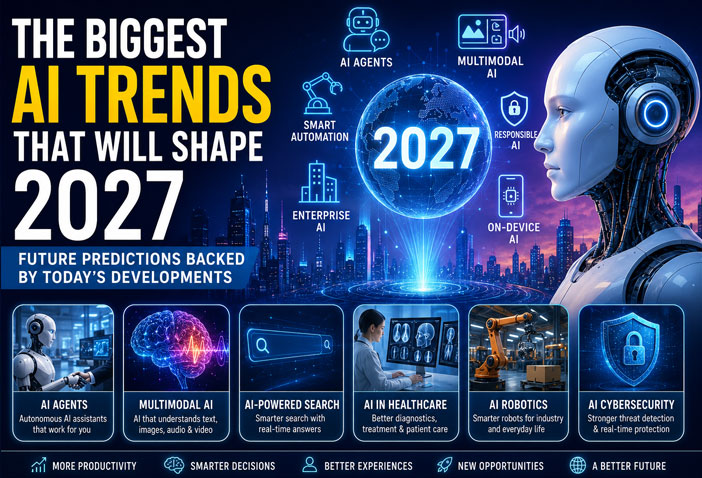
1. AI Agents Will Become Everyday Digital Employees
One of the biggest trends expected in 2027 is the widespread adoption of AI agents. Unlike traditional chatbots that respond to individual prompts, AI agents can perform complete tasks with minimal supervision.
Imagine assigning an AI assistant to organize your calendar, reply to emails, generate reports, analyze customer feedback, and schedule meetings—all without needing step-by-step instructions.
Businesses are already experimenting with AI agents for:
- Customer support
- Research
- Project management
- Data analysis
- Marketing campaigns
- Software testing
- HR processes
By 2027, many companies may treat AI agents as digital team members that work alongside employees.
2. Multimodal AI Will Become the Standard
Today’s AI systems can already understand text, images, audio, and video. In 2027, multimodal AI is expected to become the default rather than a premium feature.
Future AI assistants will be able to:
- Watch videos and summarize them
- Analyze spreadsheets
- Understand voice conversations
- Interpret images
- Read documents
- Generate presentations
- Answer questions using multiple data types
Instead of switching between different tools, users will interact with one intelligent assistant capable of understanding everything together.
This will significantly improve productivity for professionals, students, and businesses.
3. AI-Powered Search Will Replace Traditional Searching
Search engines are already evolving beyond simple lists of links. AI-powered search provides direct answers, summaries, comparisons, and personalized recommendations.
By 2027, users may rely more on AI assistants than traditional keyword searches for many everyday tasks.
Expected improvements include:
- Personalized search experiences
- Real-time summaries
- Interactive conversations
- Better source comparisons
- Faster research
- AI-generated reports
Businesses will also need to optimize content not only for traditional search engines but also for AI-powered search experiences.
4. AI Will Transform Healthcare Faster Than Ever
Healthcare is one of the industries likely to benefit the most from AI over the next few years.
AI is already assisting doctors by analyzing medical images, identifying disease patterns, and supporting clinical decision-making. By 2027, these capabilities are expected to become even more advanced.
Potential developments include:
- Earlier disease detection
- Personalized treatment recommendations
- Faster medical imaging analysis
- AI-assisted drug discovery
- Virtual healthcare assistants
- Hospital workflow automation
It’s important to note that AI is expected to support healthcare professionals rather than replace them. Human expertise will remain essential for diagnosis, treatment decisions, and patient care.
5. AI Will Become a Standard Business Tool
Just as email and cloud software became essential for modern businesses, AI is likely to become a standard workplace tool by 2027.
Small businesses and large enterprises alike are expected to use AI for:
- Customer service
- Marketing automation
- Sales forecasting
- Document creation
- Financial reporting
- Employee training
- Workflow automation
- Business analytics
Organizations that adopt AI strategically may gain a competitive advantage by improving efficiency, reducing repetitive work, and making better data-driven decisions.
6. AI-Powered Robots Will Become More Practical
Robotics has made significant progress in recent years, and 2027 could see AI-powered robots becoming more common in warehouses, hospitals, factories, retail stores, and even homes. Instead of performing only repetitive tasks, future robots are expected to understand natural language, recognize objects, and adapt to changing environments.
Businesses may use AI robots for inventory management, package sorting, quality inspection, and logistics. In healthcare, robotic assistants could help transport medical supplies and support routine hospital operations. At home, AI-powered robots may assist with cleaning, monitoring, and basic household tasks.
While widespread adoption will take time, improvements in AI reasoning and computer vision are making robots more capable than ever before.
7. Cybersecurity Will Rely More on AI
As cyber threats become more sophisticated, AI is expected to play an even larger role in protecting digital systems.
Instead of simply detecting known threats, AI-powered cybersecurity platforms can analyze patterns, identify unusual behavior, and respond to potential attacks in real time. This helps organizations detect risks before they cause major damage.
Key areas where AI is making an impact include:
- Real-time threat detection
- Fraud prevention
- Phishing email identification
- Network monitoring
- Identity verification
- Automated incident response
At the same time, cybercriminals may also use AI to create more convincing scams. This means businesses and individuals will need stronger security practices alongside AI-powered protection.
8. AI Will Personalize Education
Education is another sector where AI is expected to bring major improvements by 2027.
Instead of providing the same learning experience for everyone, AI-powered educational platforms can adapt lessons based on each student’s progress, strengths, and learning style. Teachers may also benefit from AI tools that automate grading, generate quizzes, and provide personalized learning recommendations.
Possible developments include:
- Personalized study plans
- AI tutoring assistants
- Automatic lesson summaries
- Interactive learning experiences
- Instant feedback on assignments
- Multilingual learning support
These innovations can make education more accessible and flexible, while teachers continue to play the essential role of guiding and mentoring students.
9. Responsible AI and Regulations Will Become More Important
As AI becomes more powerful, governments and organizations are placing greater emphasis on responsible AI development.
By 2027, businesses will likely need to comply with stricter regulations related to privacy, transparency, data protection, and AI accountability. Companies that develop or use AI systems may be expected to explain how their models make decisions and ensure they are used ethically.
Responsible AI practices are expected to focus on:
- User privacy
- Data security
- Transparency
- Reducing bias
- Human oversight
- Compliance with local regulations
Organizations that adopt responsible AI practices early may build stronger trust with customers and partners.
10. On-Device AI Will Become More Common
Instead of sending every request to cloud servers, many AI features are beginning to run directly on smartphones, laptops, and other personal devices.
On-device AI offers several advantages:
- Faster performance
- Improved privacy
- Reduced internet dependency
- Lower cloud costs
- Better battery optimization (through efficient AI chips)
This trend is expected to grow as hardware manufacturers continue developing processors specifically designed for AI workloads. Users may experience smarter devices without sacrificing speed or privacy.
Industries That Will Benefit the Most
Although AI is expected to influence nearly every industry, some sectors are likely to experience faster transformation than others.
Healthcare: Faster diagnostics, medical imaging, and patient support.
Finance: Fraud detection, risk analysis, and automated customer service.
Education: Personalized learning and AI tutoring.
Retail & E-commerce: Product recommendations, inventory forecasting, and customer support.
Manufacturing: Predictive maintenance, quality control, and robotics.
Marketing: Content creation, campaign optimization, and customer insights.
Software Development: AI-assisted coding, testing, and documentation.
Opportunities and Challenges Ahead
The rapid growth of AI presents exciting opportunities, but it also brings important challenges.
Opportunities
- Increased productivity
- Faster innovation
- Better customer experiences
- Improved business efficiency
- Smarter decision-making
- New career opportunities in AI-related fields
Challenges
- Data privacy concerns
- AI-generated misinformation
- Skill gaps in the workforce
- Ethical use of AI
- Regulatory compliance
- Dependence on AI systems
Businesses and individuals who continue learning and adapting will be better prepared to benefit from these changes.
Frequently Asked Questions (FAQs)
Will AI replace most jobs by 2027?
AI is expected to automate many repetitive tasks, but most experts believe it will also create new roles that require human creativity, critical thinking, leadership, and problem-solving.
Which industries will adopt AI the fastest?
Healthcare, finance, education, software development, marketing, retail, manufacturing, and customer service are among the sectors leading AI adoption.
What is the biggest AI trend for 2027?
The rise of autonomous AI agents capable of completing complex tasks with minimal human supervision is widely expected to be one of the most influential trends.
Should small businesses start using AI now?
Yes. Many affordable AI tools are already available for content creation, customer support, marketing, scheduling, and business automation. Early adoption can help businesses improve efficiency and stay competitive.
Will AI become more regulated?
Yes. Governments around the world are introducing frameworks focused on transparency, privacy, safety, and responsible AI use. Businesses should stay informed about regulations that apply in their regions.
Conclusion
Artificial Intelligence is entering a new phase of maturity. The developments we see today—such as AI agents, multimodal systems, advanced robotics, on-device intelligence, and enterprise automation—suggest that 2027 will bring even deeper integration of AI into everyday life and business.
While no prediction is guaranteed, the trends outlined in this article are grounded in technologies that are already evolving rapidly. Organizations that invest in AI skills, adopt responsible practices, and remain adaptable will be better positioned to benefit from the opportunities ahead.
Rather than viewing AI as a replacement for human expertise, the most successful businesses and professionals are likely to treat it as a powerful collaborator that enhances productivity, supports smarter decisions, and unlocks new possibilities for innovation.
Suggested for you:-
- Best AI Voice Generators in 2026 (Free & Paid Compared)
- Top AI Image Upscalers & Photo Enhancers Compared (2026)
- How AI Is Changing Customer Support in 2026
- Top AI Tools for Content Repurposing in 2026
- Best AI Meeting Assistants for Remote Teams (2026)