

Introduction
Running a small business is exciting, but it also comes with countless responsibilities. From managing sales and customer relationships to handling invoices, scheduling appointments, and marketing your products, business owners often wear multiple hats. As a result, many entrepreneurs spend more time on repetitive administrative tasks than on growing their business.
Fortunately, Artificial Intelligence (AI) is changing the way small businesses operate. In 2026, AI tools have become affordable, user-friendly, and powerful enough to automate daily tasks that once required hours of manual work. Whether you’re a freelancer, consultant, online seller, digital agency owner, or local business owner, AI can help you improve productivity while reducing operational costs.
Instead of replacing employees, AI works like a smart assistant. It organizes your schedule, manages customer conversations, creates marketing content, tracks sales, generates invoices, and even analyzes business performance. This allows business owners to focus on what truly matters—building customer relationships and increasing revenue.
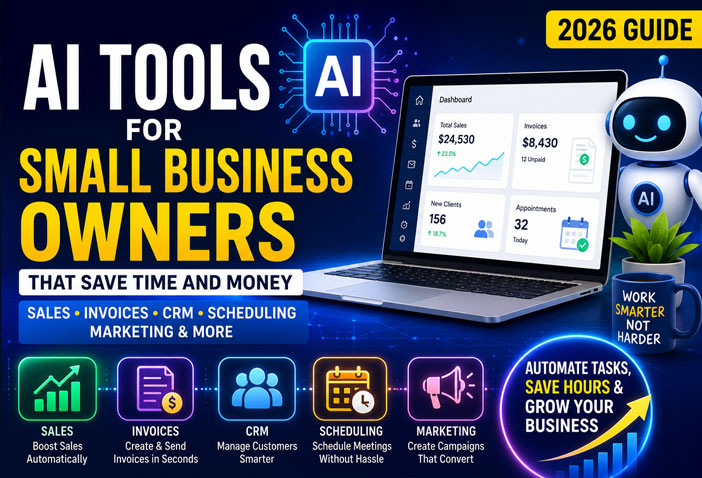
In this guide, we’ll explore the best AI tools for small business owners in 2026 and how they can help save both time and money.
Why Small Businesses Should Use AI
Many small business owners believe AI is only for large corporations with massive budgets. However, that’s no longer true. Today’s AI tools are designed specifically for startups and small businesses, offering affordable pricing and easy-to-use interfaces.
Here are a few reasons why AI has become essential for modern businesses:
- Automates repetitive daily tasks
- Reduces operational costs
- Improves customer service
- Increases employee productivity
- Generates better marketing content
- Organizes customer data
- Provides valuable business insights
- Saves hours of manual work every week
By using AI strategically, even a one-person business can operate like a much larger company.
Key Benefits of AI for Small Businesses
1. Save Time
AI automates repetitive tasks such as replying to customer inquiries, scheduling meetings, sending reminders, and generating reports.
2. Reduce Costs
Instead of hiring additional staff for routine work, AI handles many administrative tasks automatically, helping businesses lower operational expenses.
3. Increase Productivity
Employees spend less time on manual work and more time on high-value activities such as sales, customer relationships, and business growth.
4. Better Customer Experience
AI-powered chatbots and CRM systems provide faster responses, personalized recommendations, and improved customer satisfaction.
5. Smarter Decision Making
Many AI platforms analyze customer behavior, sales trends, and business performance to provide actionable insights.
Best AI Tools for Small Business Owners in 2026
| AI Tool | Best For | Free Plan | Ideal Users |
|---|---|---|---|
| ChatGPT | Content & Business Assistant | ✅ Yes | All Businesses |
| HubSpot AI | CRM & Sales | ✅ Limited | Growing Businesses |
| Zoho CRM Zia | Customer Relationship Management | Trial | Small Businesses |
| QuickBooks AI | Accounting & Invoices | Trial | Freelancers & SMEs |
| Calendly AI | Scheduling | ✅ Yes | Consultants |
| Canva AI | Marketing Design | ✅ Yes | Content Creators |
| Notion AI | Documentation | ✅ Limited | Teams |
| Jasper AI | Marketing Copywriting | Trial | Marketing Agencies |
Top AI Tools That Save Time and Money
1. ChatGPT – Your AI Business Assistant
ChatGPT has become one of the most versatile AI tools for small businesses. It can assist with writing emails, creating marketing content, answering customer questions, brainstorming ideas, generating product descriptions, and even drafting business proposals.
Whether you run an online store or a service-based business, ChatGPT can significantly reduce the time spent on content creation and communication.
Best Features
- Content writing
- Email drafting
- Business planning
- Customer support assistance
- Marketing ideas
- Social media captions
- Product descriptions
- Proposal generation
Pros
- Easy to use
- Affordable plans
- Supports multiple languages
- Saves several hours each week
Cons
- Requires fact-checking for business-critical content
Best For
Freelancers, agencies, bloggers, consultants, and startups.
2. HubSpot AI – CRM & Sales Automation
HubSpot AI helps businesses manage customer relationships from one central platform. It combines AI-powered CRM, sales automation, email marketing, and customer service into a single dashboard.
The AI analyzes customer interactions, suggests follow-ups, generates emails, and helps sales teams close deals faster.
Best Features
- AI-powered CRM
- Lead management
- Email automation
- Sales pipeline tracking
- Customer insights
- AI email generation
Pros
- Excellent CRM platform
- Beginner-friendly
- Free CRM available
- Powerful automation features
Cons
- Advanced AI tools require paid plans
Best For
Growing businesses, digital agencies, and B2B companies.
3. Zoho CRM Zia
Zoho CRM’s AI assistant, Zia, helps businesses organize customer data, predict sales opportunities, and automate repetitive CRM tasks.
It can identify sales trends, remind sales representatives about follow-ups, and generate reports automatically.
Best Features
- Sales forecasting
- Customer insights
- Workflow automation
- Email analysis
- Lead scoring
- Smart notifications
Pros
- Affordable pricing
- Excellent CRM automation
- Suitable for small teams
- Easy integration
Cons
- Requires CRM setup for maximum benefits
Best For
Sales teams, consultants, and small businesses.
4. QuickBooks AI – Smart Accounting & Invoicing
Managing invoices, expenses, and financial records manually can consume valuable time. QuickBooks AI simplifies accounting by automatically categorizing expenses, generating invoices, tracking payments, and preparing financial reports.
It also helps reduce accounting errors and provides real-time insights into business finances.
Best Features
- AI invoice generation
- Expense tracking
- Financial reports
- Tax preparation support
- Cash flow monitoring
- Payment reminders
Pros
- Saves accounting time
- User-friendly interface
- Accurate financial reporting
- Excellent for freelancers
Cons
- Monthly subscription required for advanced features
Best For
Freelancers, startups, online sellers, and service-based businesses.
5. Calendly AI – Smart Scheduling Made Easy
Scheduling meetings manually can lead to endless back-and-forth emails. Calendly AI simplifies the process by allowing clients to book available time slots automatically. It also integrates with Google Calendar, Microsoft Outlook, Zoom, and Microsoft Teams.
For consultants, coaches, freelancers, and agencies, this tool saves hours every month while reducing scheduling conflicts.
Best Features
- AI-powered meeting scheduling
- Automatic calendar synchronization
- Time zone detection
- Reminder notifications
- Zoom and Google Meet integration
- Custom booking pages
Pros
- Saves significant scheduling time
- Easy to set up
- Reduces missed appointments
- Free plan available
Cons
- Advanced automation features require a premium plan
Best For
Consultants, agencies, freelancers, and service-based businesses.
6. Canva AI – Faster Marketing Design
Creating professional marketing materials no longer requires advanced design skills. Canva AI helps business owners design social media posts, presentations, flyers, brochures, business cards, and advertisements within minutes.
Its AI-powered features can generate images, suggest layouts, write design copy, and remove backgrounds automatically.
Best Features
- AI image generation
- Magic Design templates
- Background remover
- AI writing assistant
- Brand Kit
- Social media scheduling
Pros
- Beginner-friendly
- Thousands of templates
- Excellent free version
- Great collaboration features
Cons
- Some premium templates require Canva Pro
Best For
Marketing teams, bloggers, startups, and online businesses.
7. Notion AI – Smart Workspace for Teams
Notion AI combines note-taking, documentation, project management, and AI assistance into one platform. Small businesses use it to organize SOPs, meeting notes, project plans, and internal documentation.
Its AI assistant can summarize long documents, generate content, answer questions from your workspace, and help teams stay organized.
Best Features
- AI writing assistance
- Document summarization
- Project management
- Knowledge base creation
- Team collaboration
- Task organization
Pros
- Keeps business information organized
- Improves team productivity
- Simple interface
- Excellent collaboration tools
Cons
- AI features require an additional subscription
Best For
Small teams, agencies, startups, and remote businesses.
8. Jasper AI – Marketing Content Creation
Marketing is one of the most time-consuming tasks for any business. Jasper AI helps create high-quality content for blogs, emails, advertisements, landing pages, and social media.
Instead of spending hours writing copy, businesses can generate professional marketing content within minutes.
Best Features
- Blog writing
- Email copy
- Facebook & Google Ads
- SEO content
- Product descriptions
- Brand voice customization
Pros
- Produces high-quality marketing copy
- Supports multiple languages
- Saves hours of writing time
- Great for content marketing
Cons
- Premium pricing compared to some alternatives
Best For
Marketing agencies, eCommerce businesses, bloggers, and startups.
How to Choose the Right AI Tool
Not every business needs every AI tool. Before investing, identify the tasks that consume the most time in your daily operations.
Here are a few recommendations:
- Need help writing content? → ChatGPT or Jasper AI
- Need better customer management? → HubSpot AI or Zoho CRM Zia
- Need faster accounting? → QuickBooks AI
- Need appointment scheduling? → Calendly AI
- Need marketing designs? → Canva AI
- Need team collaboration? → Notion AI
Start with one or two tools, measure the results, and gradually expand your AI toolkit as your business grows.
Free vs Paid AI Tools
| Feature | Free AI Tools | Paid AI Tools |
|---|---|---|
| Basic Automation | ✅ | ✅ |
| AI Content Creation | Limited | Advanced |
| CRM Features | Limited | Complete |
| Scheduling | Basic | Advanced |
| Customer Support | Limited | Full Automation |
| Integrations | Few | Extensive |
| Team Collaboration | Basic | Advanced |
| Business Analytics | Limited | Comprehensive |
For many small businesses, free plans are sufficient when starting out. As your customer base and workload increase, upgrading to paid plans can unlock advanced automation, analytics, and collaboration features.
Tips to Maximize AI for Your Business
To get the best results from AI tools:
- Automate repetitive tasks first.
- Integrate AI with your existing software.
- Keep customer and business data updated.
- Train your team to use AI effectively.
- Regularly review AI-generated content before publishing.
- Monitor performance and adjust workflows based on insights.
- Combine AI automation with human expertise for better customer experiences.
Using AI strategically will help you save time while maintaining quality and consistency.
Frequently Asked Questions (FAQs)
Are AI tools suitable for small businesses?
Yes. Many AI tools are designed specifically for startups, freelancers, and small businesses, offering affordable pricing and free plans.
Which AI tool is best for customer relationship management?
HubSpot AI and Zoho CRM Zia are among the top choices for managing customer relationships, tracking leads, and automating sales workflows.
Can AI replace employees in small businesses?
No. AI is best used to automate repetitive tasks and support employees. Human creativity, decision-making, and customer relationships remain essential.
Which AI tool is best for creating marketing content?
ChatGPT and Jasper AI are excellent for writing blogs, emails, advertisements, and social media content.
Are free AI tools enough for a new business?
In many cases, yes. Free versions of ChatGPT, Canva, Calendly, and Notion provide enough functionality for startups and solo entrepreneurs. As your business grows, you can upgrade to paid plans for additional features.
Conclusion
Artificial Intelligence is no longer a luxury reserved for large enterprises. In 2026, it has become an essential business partner for startups, freelancers, agencies, and small business owners looking to work smarter rather than harder.
From managing customer relationships and creating marketing campaigns to automating invoices and scheduling meetings, AI tools can save countless hours every week while reducing operational costs. More importantly, they allow business owners to focus on innovation, customer satisfaction, and business growth instead of repetitive administrative work.
The key is to start small. Identify the tasks that take up the most time, choose AI tools that address those challenges, and gradually expand your AI workflow. Businesses that embrace AI today will be better equipped to compete, scale, and thrive in the increasingly digital marketplace of tomorrow.
Suggested for you:-
- Best AI Voice Generators in 2026 (Free & Paid Compared)
- Top AI Image Upscalers & Photo Enhancers Compared (2026)
- How AI Is Changing Customer Support in 2026
- Top AI Tools for Content Repurposing in 2026
- Best AI Meeting Assistants for Remote Teams (2026)